
Family formals are the part of the day that is easy to underestimate. The photography is not hard. A group photo is technically simple. The hard part is gathering a crowd of people who do not work for you, do not know the plan, and are mid-conversation with a drink in hand.
That makes wedding group photos tips mostly a matter of logistics. A good list, a helper who knows the guests by sight, and a bit of advance notice do more than any camera skill. This article explains why formals stretch, what you can control, and how to protect the rest of your afternoon.
Quick answer: The biggest thing that blows out a formals timeline is people who are not where they are meant to be. A short list (a dozen or so combinations, not thirty), a named helper who is not the couple, and a time window you have agreed with your photographer keep this part of the day fast. Tell the people on the list where and when to be before the day, and do the formals straight after the ceremony.
On this page
- Why formals take longer than couples expect
- What actually slows a formals session down
- How to build a list that does not eat your afternoon
- Where and when formals should happen
- The wrangler system, and why it works
- Telling your guests before the day
- Handling requests, awkward families and the group nobody wants
- Making the session itself calmer
- Questions to ask your photographer about formals
- What to do next
Why formals take longer than couples expect
Each group photo is really four small jobs. Someone has to be found, the group has to be gathered, everyone has to be arranged so no face is hidden, and then the photographer needs a frame where nobody is blinking or looking away. With two people that takes seconds. With fifteen it does not scale in a straight line, because the odds that one person has a closed eye or a turned head go up with every extra face.
Then there is the gap between the list and the people. A list is a piece of paper. Guests are scattered across a garden or a foyer, holding glasses, hugging people they have not seen for years. Gathering them is the slow part, and it happens for every combination, not once.
A worked example makes the arithmetic plain. Say you have 14 combinations on your list, and say, as an assumption only, that each one takes two minutes from the first name being called to the last frame. That is 28 minutes before anyone goes missing. Now say three combinations each lose a minute while someone is tracked down. You are past half an hour, and your list was a modest one. Your own numbers will differ, which is why you should ask your photographer how long they allow per combination for a family like yours.
The lesson in the example is that time does not go into the shutter. It goes into the pauses between frames. Everything that follows is about shrinking those pauses.
What actually slows a formals session down
Missing people. This is often the biggest cost. Someone has gone to find the bathroom, someone is deep in conversation across the lawn, someone has not realised they belong in this particular combination. Every missing person freezes the whole group, because everyone else stands and waits.
A list that is too long. Thirty combinations sounds thorough on paper and is tiring to carry out. People run out of patience, children get restless, and smiles get thinner as the list goes on. A late combination is often a worse photograph than an early one for the plain reason that everyone is tired of standing.
Nobody directing except the photographer. A photographer can call a name, but cannot know that “Aunty Linda” is the woman in the blue dress near the drinks table. A person who knows the guests by sight is worth more than a perfect list.
Drinks. Once guests have a glass in hand and a canapé in the other, they scatter and linger. Formals held after the drinks begin take more chasing than formals held while everyone is still gathered from the ceremony. The reasons need no explaining.
Combinations nobody actually wanted. Some lists are built by adding together every relative’s request, instead of the couple deciding what they want. The result is long, a bit resented, and full of photos that will never be framed or looked at again.
How to build a list that does not eat your afternoon
Aim for a dozen or so combinations. That is a working guide, not a law, and a smaller family can be shorter. Structure it in blocks, from the people you most want photographed down to the ones you could live without.
| Block | Typical combinations |
|---|---|
| Immediate family | Couple with each set of parents, couple with siblings, whole immediate family |
| Extended family | Grandparents, then each side’s extended group if it is large |
| Bridal party | Full party, bridesmaids only, groomsmen only |
| Special requests | Anyone travelling from overseas, anyone with a reason to be in a photo that cannot be repeated |
Write each line as named people, not a label. “Couple with Anna’s parents and her brother Tom” is a line a helper can act on. “Anna’s family” is an argument waiting to happen.
Order the list so that groups share people. Start with the largest group, then peel people away. Whole immediate family first, then take out the siblings, then the parents. Each step is a person leaving the frame rather than a fresh gathering, which is much faster than calling a new group every time.
If you have to cut, cut the extended family block first and keep the bridal party. Extended groups are the slowest to assemble, the least often printed, and the easiest to replace with a candid at the reception. That is a recommendation, and plenty of families will disagree, which is fair. Some families would rather lose the bridal party shots and keep every cousin. It is your list.
Anything beyond the core is a trade. You are exchanging portrait time or evening light for combinations that mostly exist because someone was asked and felt they had to say yes. It is fine to say no to a request that does not fit. That is a conversation to have with family before the day, not on it.
Where and when formals should happen
Straight after the ceremony is usually fastest, because everyone is already dressed, already in one place and has not yet dispersed. Waiting until later in the reception means collecting people who have scattered, and some of them will have changed out of their good shoes or gone home with a sleeping child.
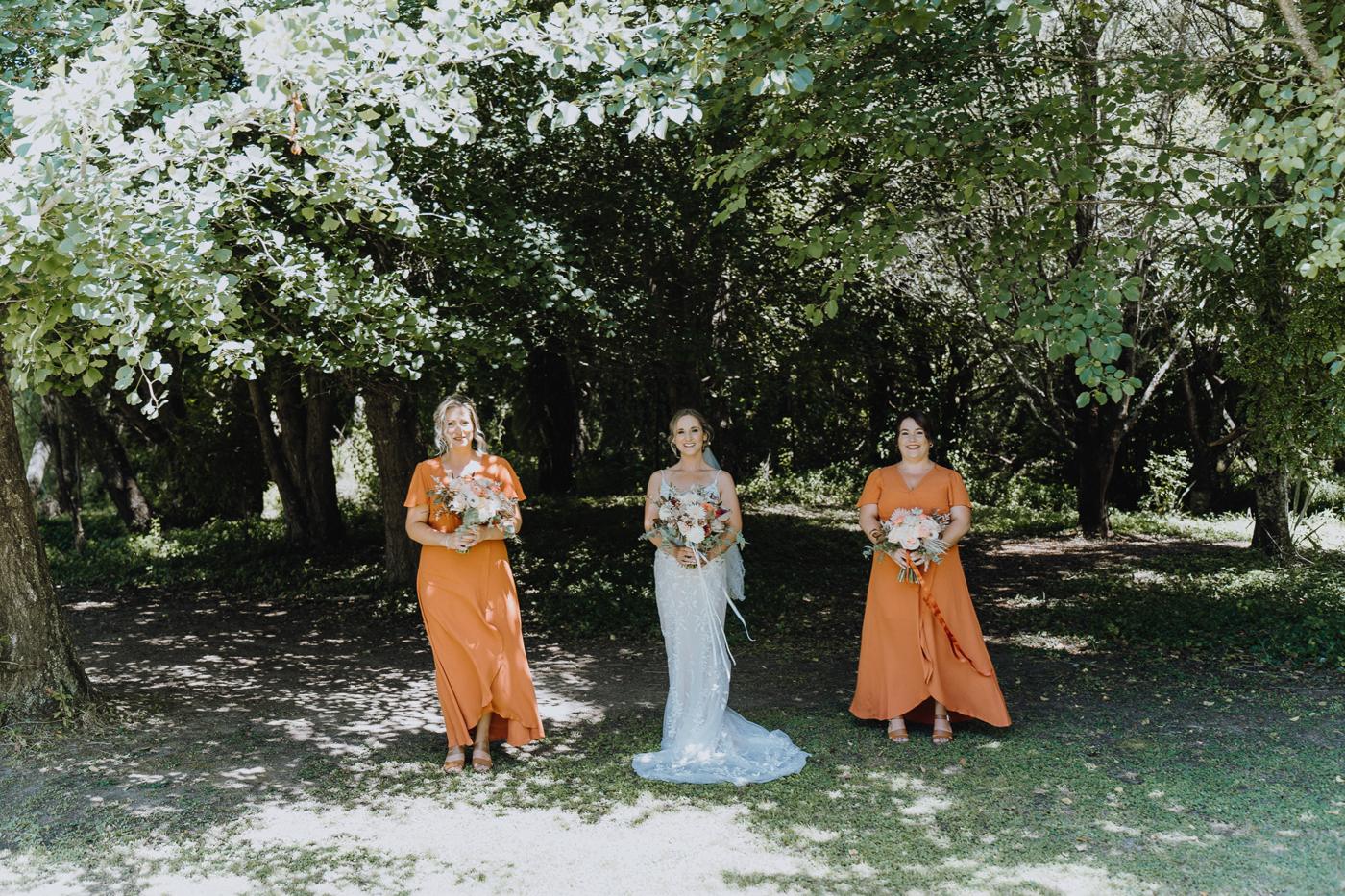
Choose the spot before the day. A formals location needs a few plain things: a bit of shade or even light, enough room for a big group to stand two or three rows deep, a background that is not busy, and somewhere guests will not be walking through. A quiet corner of the garden beats a pretty spot beside the main path.
Light matters more than it seems, and it varies with the season and the place. In summer a late-afternoon ceremony may leave you with plenty of light after formals. In winter the same clock time may leave you with very little. If you are marrying somewhere with a tall wall or building to the west, the sun can drop behind it early. Ask your photographer to look at the light for your date, and see Sydney golden hour by month for how the light shifts through the year.
Hot days need a plan too. Guests standing in full sun get squinty and uncomfortable, and shade is a kindness to everyone. If your timeline already feels tight, read how much time family formals really need alongside this article.
The wrangler system, and why it works
The most useful single thing you can do is name a helper. Call them a wrangler. This is someone other than the couple who knows the guest list by face, stands next to the photographer, calls the names, and physically walks off to retrieve people who have wandered. A sibling, a close cousin, a friend from the bridal party, or a parent who likes being useful all work.
Why it works is mechanical. The photographer cannot leave the group to find someone, because a photographer who walks off is a photographer who is not photographing, and the group left standing starts to dissolve the moment attention turns away. A wrangler fills that gap. While one person is being collected, the next combination can already be forming.
The helper should not be the couple. You will be in nearly every photo, and you cannot gather the next group while standing in the current one. They also should not be someone who is in most of the combinations, because then they will be on the wrong side of the lens. Pick someone sociable and mildly bossy, who will not mind calling out across a lawn.
Give the helper a printed or phone copy of the list, written with first names and a note on who is who (“Uncle David, tall, grey jacket”). Ask them a week or two before the wedding, not on the morning. It is a real job with a real function, not a token role, and some people will want to know what they are signing up for.
If nobody obvious volunteers, ask someone directly. A clear, specific request is easier to say yes to than a vague one.
Telling your guests before the day
The second most useful thing is telling the people on the list where and when formals are happening. Not on the day, in the afterglow of the ceremony, when they are being tracked down by a stranger with a camera. Send a message the week before, or put it on the order of the day card.
A one-line message is enough. Something like: “Family photos straight after the ceremony, near the garden. Please stay close and do not wander off.” That is the whole message. Add a line for anyone who will need to be there for a particular group (“Mum, Dad, Anna and Tom, you are in the first photo”).
A few extra things are worth saying in the same note:
- Where to gather, described by a landmark (“by the big tree on the left of the entrance”)
- That drinks and canapés come after the photos
- Who the helper is, so guests know who to follow
The message works because it removes the surprise. A guest who knows photos are coming will not drift to the bar. A guest who does not know will treat the call to the lawn as an interruption.
Children are a special case. Tell parents of small children when their group is, so they can have a child fed, rested and in the right place. A group with a hungry toddler is slow, and a toddler asleep on the way is slower.
Handling requests, awkward families and the group nobody wants
Every family has some combination that is not simple. Separated parents who prefer not to stand together, a step-parent who is unsure of their place, a relative who insists on a particular photo. These are ordinary planning problems, and the way to solve them is before the day.
Have the conversation yourself or ask a trusted relative to. Settle which combinations are in and which are out. For separated parents, one solution is to photograph the couple with each parent or parent pair separately, which keeps everyone comfortable and costs a little more time. Tell your photographer in advance so the list reflects it and the helper does not call a combination that will cause tension.
When a relative asks for a photo that is not on the list, give a clear and kind answer in advance. “We have kept the formals short so we can spend time with everyone at the reception, and we would love a candid of you then” is polite and true. Your photographer can often take that candid later if asked. It is easier to say yes to a candid than to add a combination in the middle of the session.
If someone is not photographed in a formal, it is not a tragedy. The reception and the quiet moments around it give many chances for natural groups.
Making the session itself calmer
Formals are a logistics exercise, not a creative moment. Save your energy and patience for the couple portraits that follow, where the pace slows down and the photography gets interesting again. A few habits make the session easier for everyone.
Keep the couple in place. You are in many of the photos, so stand where the camera is and let guests come to you. Wandering off to say hello breaks the rhythm.
Use a clear call. A single voice calling the next group, usually the photographer with the helper repeating it, is better than three people shouting. Guests respond to a calm, confident instruction.
Allow for an overrun. If the list is realistic, a small cushion in the timeline absorbs the delays that always happen. If the timeline has no cushion, a late guest will cost your portraits.
Take the formal style for what it is. Formals are traditional in style: everyone together, looking at the camera, clean and clear. Couple portraits are a different kind of work and need real time. The two serve different purposes. If you are unsure which style suits you, documentary, editorial or traditional explains the difference.
If you are a bit camera-shy, formals can feel like an exam. They are the opposite of the quiet, unposed moments. Keep them short, keep them organised, and the rest of the day can be as natural as you like.
Questions to ask your photographer about formals
Before you book, and again at the planning stage, ask a few direct questions. The answers show you how a photographer works and whether their method suits your family.
- How long do you allow per combination, and how long for a list of our size?
- Where do you recommend we shoot formals, and how do you choose the spot?
- Do you want a helper from our side, and what do you need that person to do?
- What happens to the schedule if formals overrun?
- Can candid group photos at the reception stand in for some of the extended family?
- How do you handle a family member who wants extra combinations on the day?
A photographer who has clear answers has thought about this part of the day. A photographer who says “we will see on the day” has not, and that is useful to know before you book. Questions worth asking a wedding photographer before you book has more to ask.
If your family is large, the same ideas apply at a bigger scale. See large family formals for how to queue forty relatives without losing the light.
What to do next
- Write your list as named people, in blocks, with the biggest groups first and the optional extended groups last. Keep it short enough that you could say it aloud in one breath per block.
- Choose a helper who knows the guests by sight, and ask them a week or two before the wedding. Give them a copy of the list with a note on who is who.
- Send one clear message to the people on the list: where to be and when, straight after the ceremony. Add it to the order of the day card too.
- Agree the plan with your photographer. Ask how long they allow, where the formals will happen, and how it fits your timeline. Our order of the day and light planner is a useful place to start.
- Settle any awkward combinations with family before the day, so the session has no surprises.
For how coverage and pricing work, see the investment page.
Building your formals list and not sure where to start? Check your date on the contact page and Binh will tell you straight away whether he is free and what the day could look like.