
Most wedding timeline advice says to plan your portraits around golden hour. Very little of it tells you when that is where you are getting married.
So this page gives you the real numbers for a Sydney golden hour wedding: sunrise, golden hour, sunset and the end of usable light, for every month of 2027, plus a method for turning them into a ceremony time you can actually book.
Quick answer: In Sydney, golden hour starts between 33 and 38 minutes before sunset, depending on the month. Sunset runs from 4:53pm in mid-June to 8:09pm in mid-January, and the biggest trap is autumn, when sunset falls 101 minutes earlier between 15 March and 15 April because daylight saving ends partway through. Choose your ceremony time from the table for your wedding month, never from the evening you visited the venue.
On this page
- The table
- How to read it
- Your venue is not the CBD
- The daylight saving trap
- Winter weddings and the short day
- Summer weddings and the late sunset
- Working backwards to your ceremony time
- First look: moving the portraits out of the evening
- When the day slips, and what to do the week before
- What to do next
The table
These times are for Sydney CBD in 2027, computed with the standard NOAA solar position method rather than copied from a weather site. Golden hour here means the sun is six degrees above the horizon, which is roughly where the light turns warm and directional and stops being harsh. Civil dusk is when the sun is six degrees below the horizon. After that you are working with artificial light or very little of it.
| Date (2027) | Sunrise | Golden hour starts | Sunset | Civil dusk | Golden hour length | Clock |
|---|---|---|---|---|---|---|
| 15 January | 5:59am | 7:33pm | 8:09pm | 8:38pm | 36 min | AEDT |
| 15 February | 6:30am | 7:15pm | 7:48pm | 8:15pm | 34 min | AEDT |
| 15 March | 6:54am | 6:41pm | 7:14pm | 7:39pm | 33 min | AEDT |
| 15 April | 6:17am | 4:59pm | 5:33pm | 5:58pm | 34 min | AEST |
| 15 May | 6:40am | 4:27pm | 5:03pm | 5:30pm | 36 min | AEST |
| 15 June | 6:58am | 4:15pm | 4:53pm | 5:21pm | 38 min | AEST |
| 15 July | 6:58am | 4:27pm | 5:04pm | 5:31pm | 37 min | AEST |
| 15 August | 6:35am | 4:50pm | 5:25pm | 5:51pm | 35 min | AEST |
| 15 September | 5:56am | 5:13pm | 5:46pm | 6:11pm | 33 min | AEST |
| 15 October | 6:15am | 6:35pm | 7:08pm | 7:34pm | 33 min | AEDT |
| 15 November | 5:44am | 7:01pm | 7:36pm | 8:03pm | 35 min | AEDT |
| 15 December | 5:38am | 7:25pm | 8:02pm | 8:31pm | 37 min | AEDT |
Times will differ slightly in other years, so treat this as a planning table and not a promise.
Your wedding is probably not on the 15th. Look at the rows either side of your date. Outside the clock-change weeks the sunset moves by a few minutes every few days, so you will not be far out.
How to read it
Three things in that table matter more than the rest.
Golden hour is shorter than people expect. It is 33 to 38 minutes, never an hour, and longest in midwinter, when the sun comes down at a shallower angle. If your timeline says “one hour of golden hour portraits”, it has booked more light than exists. Plan on about half an hour.
Sunset is not the end of the light. The gap between sunset and civil dusk is 25 to 29 minutes in every month. In that window the sky is still bright, soft and often coloured, and the light on faces is even and kind. Some of the quietest frames of a wedding happen there, so a photographer who packs up at sunset is leaving the gentlest light unused.
Sunrise matters less. It counts for an early getting-ready or a sunrise elopement. The column is there because daylight length shapes the whole day: about 9.9 hours of sun in mid-June, about 14.4 in mid-December. That is why a summer and a winter wedding cannot share a timeline.
Your venue is not the CBD
The table assumes a clear, flat horizon. Your venue may not have one.
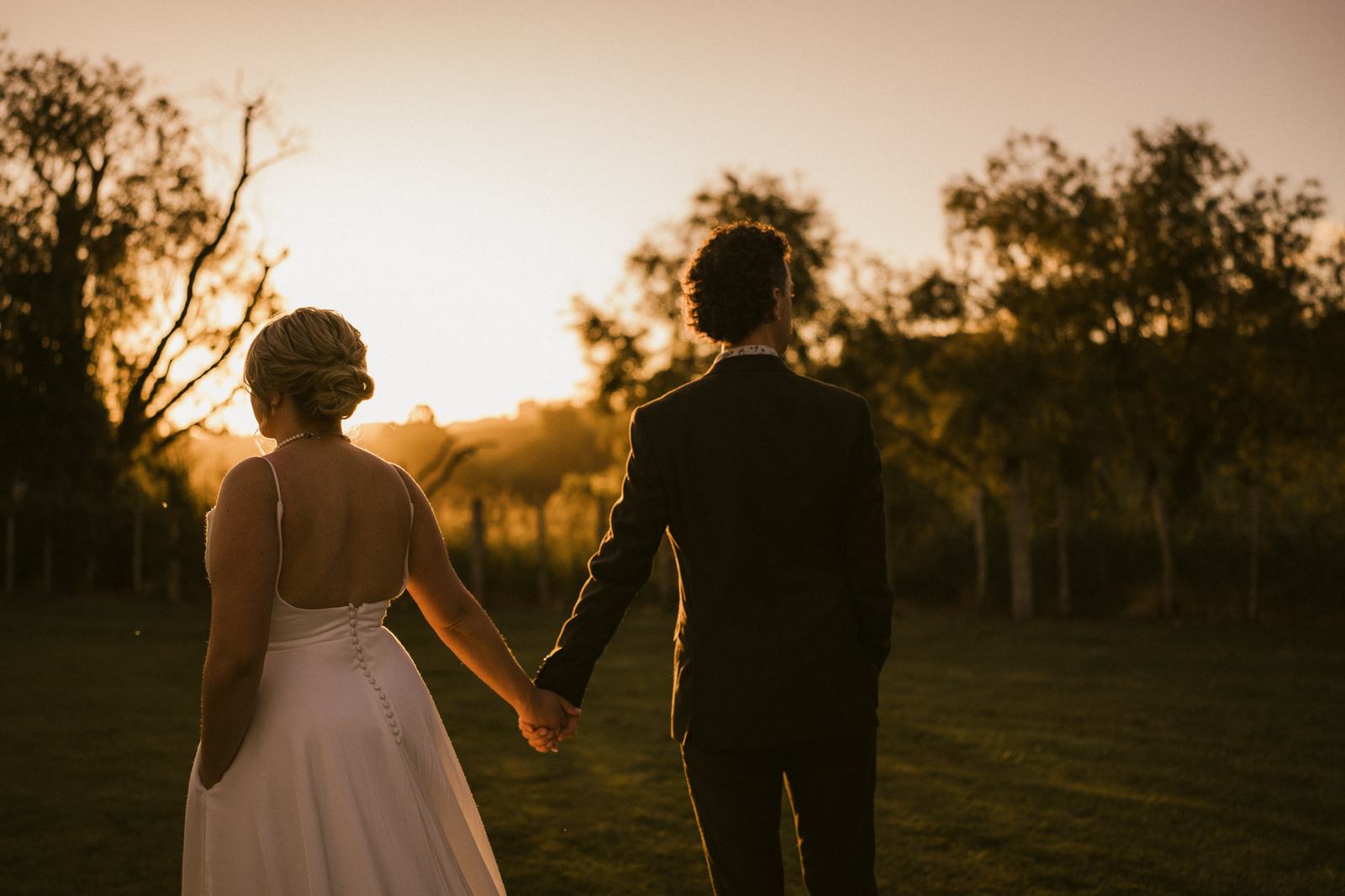
Sunset times describe when the sun touches the horizon. What you experience is when it drops behind whatever stands between you and that horizon: a ridge, a headland, trees, the building next door. A venue with something tall to its west can lose direct sun well before the table says, and a deep valley can be worse. A waterfront with open water to the west keeps every minute.
The table tells you the earliest the light can end, and your site can only make it earlier. If the venue has open ground to the west, use the table as it stands. If there is a hill, headland or tall building to the west, assume the usable light ends earlier and ask your photographer how much. If you do not know, assume something is in the way and plan for earlier light.
A few questions worth asking the venue and your photographer:
- Which way does the ceremony space face, and where is the sun in it at the time we are planning?
- Is there a spot on the grounds with an open view west, and how far is it from the ceremony?
- If the main lawn goes into shade early, where can we walk to quickly?
If you want the full picture of how a coastal, harbour or western location changes things, there is a separate piece on how harbour, beach and western Sydney change the light.
The daylight saving trap
In New South Wales the clocks go forward on the first Sunday in October and back on the first Sunday in April. (Confirm the current dates on the official NSW Government site before you build a timeline on them.) Look at what that does to sunset around the changeovers:
| Date (2027) | Golden hour starts | Sunset | Clock |
|---|---|---|---|
| 1 March | 6:59pm | 7:32pm | AEDT |
| 15 March | 6:41pm | 7:14pm | AEDT |
| 1 April | 6:18pm | 6:51pm | AEDT |
| 15 April | 4:59pm | 5:33pm | AEST |
| 15 September | 5:13pm | 5:46pm | AEST |
| 1 October | 5:24pm | 5:57pm | AEST |
| 15 October | 6:35pm | 7:08pm | AEDT |
From 15 March to 15 April, sunset moves from 7:14pm to 5:33pm. That is 101 minutes earlier in a single month. Around 20 minutes a fortnight is just the season at work (1 March to 15 March is 18 minutes, 15 March to 1 April is 23). The other hour is the clock going back. Because the change lands in the middle of the drift, the fall is abrupt, not gradual.
In spring it runs in reverse: from 1 to 15 October sunset jumps 71 minutes later, the clock going forward plus a normal fortnight of lengthening days.
Here is how it goes wrong, as a worked example. Say you view a venue in mid-February at 7:30pm. The light is golden and you book, with a 4:30pm ceremony because you picture the same glow in the afternoon. Your wedding turns out to be in mid-April. Assume a 30-minute ceremony and 20 minutes of congratulations: it ends at 5:00pm and formals begin at about 5:20pm. Golden hour started at 4:59pm, sunset is 5:33pm and civil dusk is 5:58pm. Couple portraits happen in dusk or not at all. Nobody was careless. The venue visit was in the wrong half of the year.
The fix is to read the table for your wedding month, never your viewing month. If you booked more than a year out, daylight saving and your ceremony time covers that in full.
Winter weddings and the short day
In mid-June the sun sets at 4:53pm and golden hour starts at 4:15pm. That is not a reason to avoid a winter wedding. Winter light in Sydney is lower and often softer than summer light. But the shape of the day has to change.
A winter wedding that wants outdoor portraits in good light needs an early-afternoon ceremony. Say a 4pm ceremony in June runs 30 minutes: it ends at 4:30pm, with the light almost finished. A ceremony at about 2:20pm (worked out below) leaves room for the congratulations and the formals, and puts you outside as golden hour begins. It feels early for a wedding, but it is the time the light dictates.
There are two sensible ways to run a winter day. Either an early ceremony, so the ceremony, formals and portraits all happen in daylight and the reception runs into the evening. Or a later ceremony, accepting portraits at dusk or indoors and putting the effort into the reception. Both are fine if chosen on purpose. What does not work is planning a summer-shaped day in June and hoping the sun will wait. There is more in the piece on winter weddings in Sydney.
Summer weddings and the late sunset
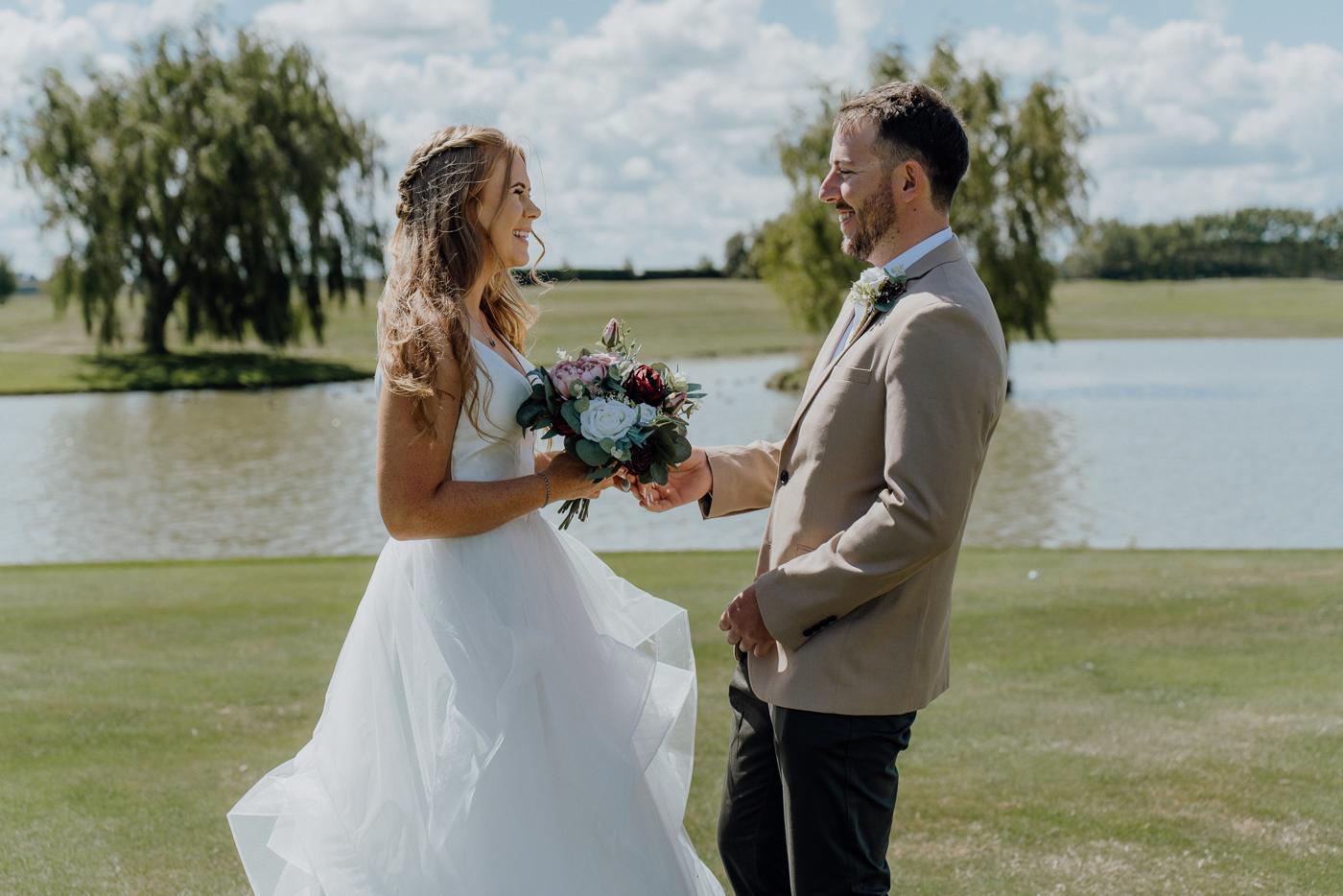
The mirror image of winter is summer, and it catches couples out in the opposite direction. On 15 January the sun sets at 8:09pm and golden hour does not begin until 7:33pm. Say you set a ceremony at 6pm and it runs 30 minutes: it is over by 6:30pm, and the best light will not arrive for another hour.
That is not a disaster. You can plan the portraits for the middle of the reception: dinner is underway, and the two of you slip out for a short break at golden hour. Put the break in the timeline so it is a feature and not an interruption. Or push the ceremony later: working backwards from 7:33pm (method below), a ceremony around 5:40pm puts the portraits in golden light straight after the formals.
If the ceremony is in the early afternoon, the light on faces will be overhead and hard, and open shade becomes your friend. The planning rule is simple: the later the ceremony in summer, the easier the light.
Working backwards to your ceremony time
Start at the end of the evening and work back. The durations below are assumptions for one example wedding, not rules. A larger family or a longer ceremony pushes them out, so ask your photographer how long they need for each block.
- Find the golden hour start for your month in the table.
- Subtract a buffer (the example uses 20 minutes) if your venue might have anything to its west. If you do not know, assume it does.
- That is when you want to be standing somewhere good with just the two of you. The example allows 30 minutes.
- Before that, family formals (the example uses 45 minutes, and a big extended family on either side needs more). There is a separate piece on how much time family formals really need.
- Before that, congratulations and hugs (the example uses 20 minutes). This tends to run longer than couples expect, and it should.
- Before that, the ceremony itself (the example uses 30 minutes, which suits a short civil ceremony; a church service or one with extra rituals runs longer).
Here are three worked examples using those assumed sizes and the 2027 times from the table.
| Wedding date | Golden hour starts | Portraits begin | Formals begin | Congratulations begin | Ceremony starts |
|---|---|---|---|---|---|
| 15 January | 7:33pm | 7:13pm | 6:28pm | 6:08pm | about 5:38pm |
| 15 April | 4:59pm | 4:39pm | 3:54pm | 3:34pm | about 3:04pm |
| 15 June | 4:15pm | 3:55pm | 3:10pm | 2:50pm | about 2:20pm |
Shorten the formals by 15 minutes and the ceremony can start 15 minutes later in each case.
Mid-April lands at about 3pm, against the 4:30pm from the earlier example. That gap is partly the season and partly the clock change. And January to June is the same wedding starting three hours and eighteen minutes apart.
A gap between the end of the ceremony and golden hour is not wasted. It is room for drinks or a quiet break. The Sydney wedding day timeline has the full order of the day.
First look: moving the portraits out of the evening
If the numbers say your portrait light arrives too late, or too early to be worth building around, a first look is the main tool for taking the light out of the equation.
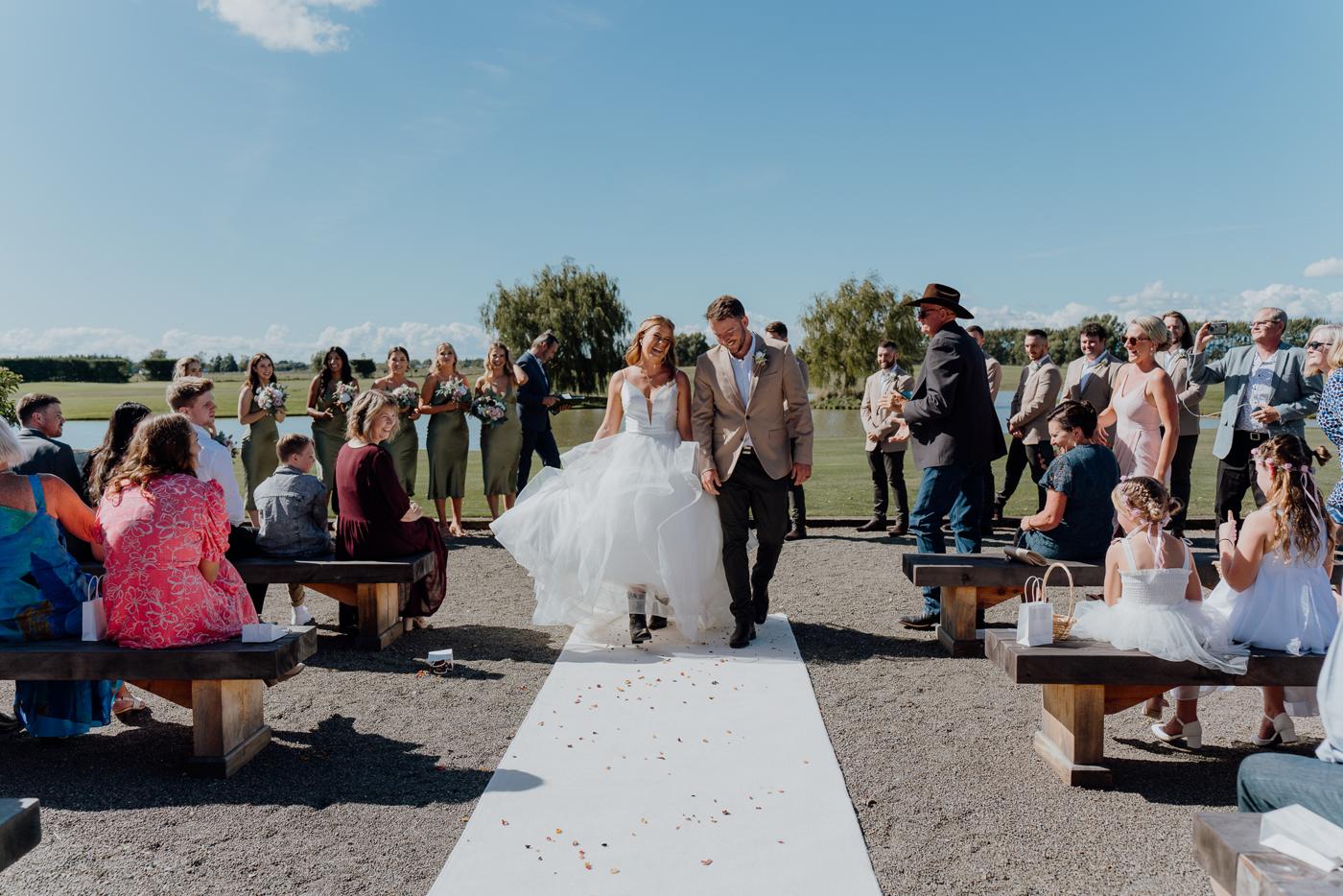
A first look means seeing each other privately before the ceremony and doing the couple portraits straight away. Your portraits stop depending on the evening sun, you pick the nicest light of the afternoon, and a 4pm ceremony in June stops being a problem because the portraits are already done. The trade-off is real: you give up the aisle moment, where one of you sees the other while everyone watches. Neither choice is better. It depends which you would rather keep. There is a fuller comparison in first look or not.
If you do not do a first look, the plan above still works. You just need to respect the table.
When the day slips, and what to do the week before
Light keeps its own schedule, so the planning has to be done before the day. These are the usual ways a timeline slips, each with its cause.
The ceremony starts late. Guests are still arriving, a car is stuck, someone is finishing a button. With no slack before golden hour, any delay eats directly into your portraits. That is why the method includes a buffer.
Congratulations takes longer than planned. It tends to, because everyone wants to speak to you. Let it stretch and trim something else.
Formals grow. A short list of groups grows once people remember cousins. Write a short list beforehand and name one person on each side to gather relatives.
Portraits get left until last. Any delay in the afternoon then pushes them past the light. Give them a fixed start time with the formals ahead of them.
The weather changes the sky, not the clock. On an overcast day the golden light will not appear, but soft, even light lasts all afternoon, which is a gift for portraits. The sun still sets at the time in the table.
If the day runs late, ask your photographer whether they will step out at golden hour, even if that means leaving the reception for a few minutes.
The week before the wedding, run through this:
- Check sunset and golden hour for your exact date, not the 15th of the month.
- Work backwards from golden hour and write the times down, including the buffer.
- Tell the celebrant, venue and anyone running the day the ceremony start time, and which clock it is (AEDT or AEST).
- Name one person to help gather family for the formals.
- Agree where you will go for portraits if the first spot is in shade or rain.
What to do next
- Find your month in the table and note golden hour, sunset and civil dusk, plus the rows either side.
- Work backwards from golden hour and see what ceremony time it suggests. If it is earlier than you imagined, better to learn that before the date is booked.
- Check the horizon at your venue. Ask which way the ceremony space faces and whether anything stands to the west.
- Decide whether a first look suits you. If the light is awkward for your month, it is the cleanest fix.
- Try the order of the day and light planner, and browse the tips library for the rest of the plan.
If you would like to know what the light could do on your actual date and venue, check your date and I will tell you straight away whether I am free and what the day could look like.