
“Documentary” is a common word in wedding photography and a rarely explained one. It is easy to define it as a philosophy (“real moments, no posing”) and stop there, but that only tells you what a photographer believes. It leaves out what they are physically doing at 11am, at the ceremony, or while you eat.
So here is documentary wedding photography laid out hour by hour, for one example day, with the reason each stretch is shot the way it is. Use it to understand what you are buying, and to check that any photographer’s idea of “documentary” matches yours.
Quick answer: Documentary coverage means the photographer works continuously and reactively for most of the day, reading what is about to happen and being in place before it does. The heaviest shooting falls on getting ready, the ceremony and the speeches. The lightest falls on the meal, on purpose. Directed portraits and family formals still happen, and they are a different mode inside the same day.
On this page
- What documentary coverage means in practice
- The hour-by-hour breakdown
- Getting ready: the quiet kind of busy
- The ceremony: reactions, not just vows
- The directed hours: formals and portraits
- The reception: speeches, the meal and the dance floor
- Where documentary coverage can go wrong
- Choosing what to protect if you book fewer hours
- What to do next
What documentary coverage means in practice
A traditional approach arranges people and then photographs the arrangement. Documentary work waits for the day to produce something, with a camera already pointing the right way.
At TZ Wedding Studios that means real moments as they happen for most of the day, with gentle guidance for portraits. Prompts stay simple and nothing is over-posed. Camera-shy couples are normal, and documentary work suits them well, because most of the day nobody is asked to perform. The style is fine art for the quiet moments and quick hands for the loud ones.
Two things follow from that, and both explain the rest of this article.
First, the shooting rate is not constant. A photographer working reactively shoots a great deal when things are happening and almost nothing when they are not. If every hour of a gallery looks equally heavy, the photographer was shooting to a rhythm of their own rather than to the day’s.
Second, a lot of the skill happens when the camera is down. Anticipation is the job. By the time a moment is obvious enough to react to, the best version of it is often already over.
If you are still deciding between approaches, documentary, editorial or traditional compares them side by side. This article stays with documentary and shows what it looks like across a full day.
The hour-by-hour breakdown
This is a worked example, and every time in it is an assumption. Say you are having a ten-hour day: coverage starts at 11:00 with getting ready, the ceremony is at 3:00pm, and coverage ends at 9:00pm with the dance floor. Your real day will shift all of these lines, so read the shape and not the clock.
| Time | What is happening | What the photographer is doing | Shooting load |
|---|---|---|---|
| 11:00am | Getting ready | Details, hands, nerves, the dress going on, the room | Heavy |
| Late morning | Travel and buffer | Mostly watching, shooting only if something happens on the way | Light |
| Before the ceremony | Guests arriving | Arrivals, the waiting partner, the ceremony space | Medium |
| 3:00pm | Ceremony | Vows, reactions, the walk, the kiss | Heavy |
| After the ceremony | Congratulations | Hugs and first reactions | Medium to heavy |
| Afternoon | Family formals | Directed, traditional, a different mode | Medium, steady |
| Afternoon | Couple portraits | Directed lightly, then left to be themselves | Medium |
| Early evening | Reception opens | Guests mingling, room details | Medium |
| Evening | Speeches, first dance | Reactions, many of them unrepeatable | Heavy |
| Evening | The meal | Deliberately minimal | Minimal |
| Up to 9:00pm | Dancing | Fast, reactive, often low light | Heavy |
The table has no frame counts on purpose. A count only means something for the day it came from, and it can mislead you into judging coverage by volume. For what the hours themselves buy, a 6, 8 and 10-hour day compared covers it, along and as a starting point, six hours usually ends before the speeches, eight is what most couples choose, and ten is what nobody regrets.
Getting ready: the quiet kind of busy
The first stretch of the day looks calm and is full of material. Nerves show up here, and so do the people who will not be in a single other photograph, a mother with a necklace clasp or a friend steaming a hem.
Getting ready is also the section where documentary and fine art meet. The light through a window, a dress hanging on a door, a pair of hands: these are patient pictures, and a photographer who works reactively can still compose them carefully because nothing is rushing past. This is where the “fine art for the quiet moments” half of the approach lives.
The practical point for you is time. Getting ready can easily run late, and a documentary photographer is photographing people in the middle of a process, not a performance. Build slack in. The photographer does not need everyone ready. They need people being ready, and that is a different thing to photograph. The getting-ready buffer nobody builds in goes through how to plan the margin.
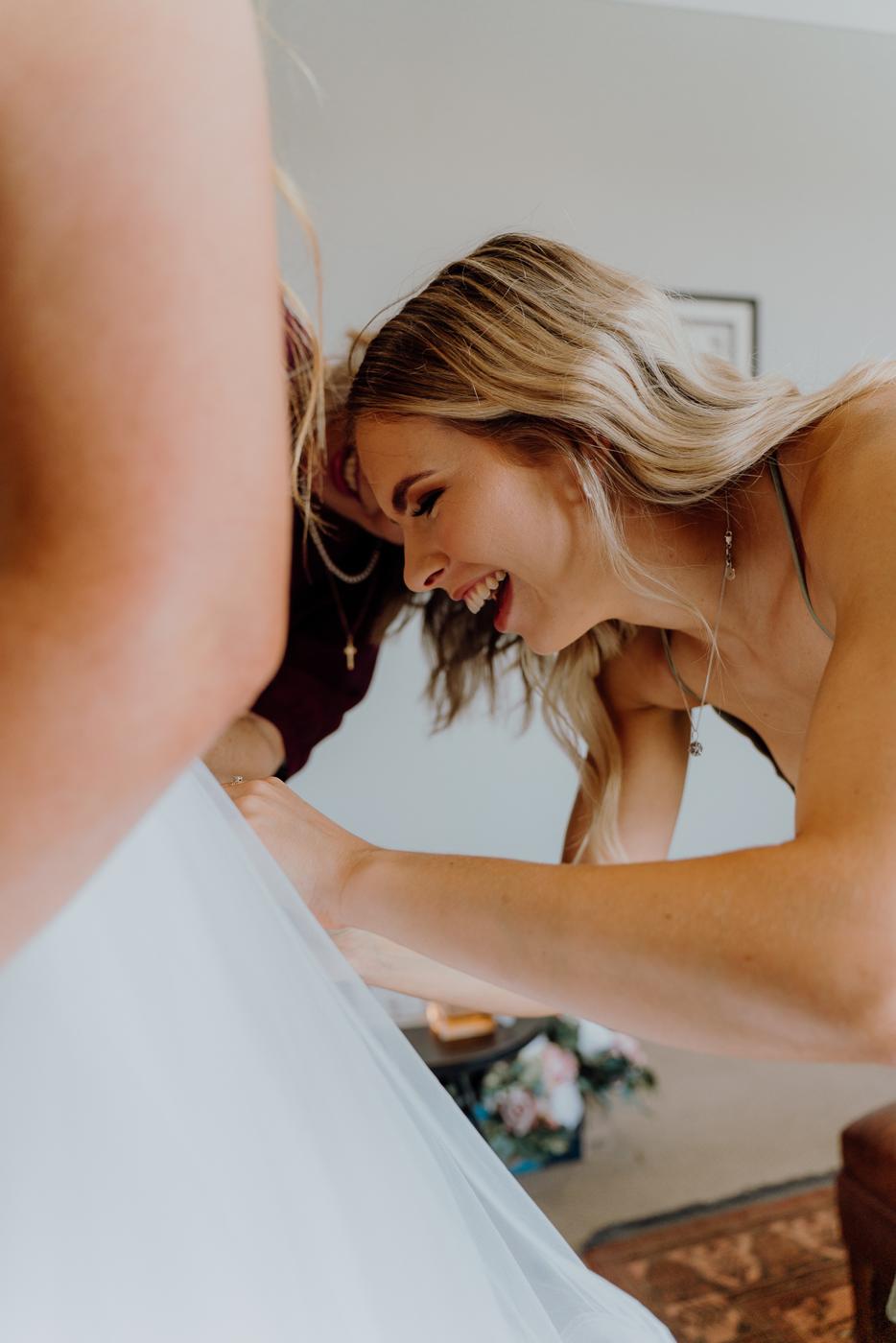
Two requests help at this stage:
- Ask whoever is in the room to carry on as normal rather than stopping to pose when the camera appears.
- Clear the surfaces. A bathroom counter covered in products and cables ends up in the background of every detail photograph, and nobody wants to edit it out of every frame.
The ceremony: reactions, not just vows
At a ceremony the main events are fixed and public. The vows, the rings and the kiss will be photographed by everybody, including guests with phones. What a documentary photographer adds is the other half of the room.
A ceremony has two stories running together: what is happening at the front, and what it is doing to people watching. The partner who looks down and tries not to cry. A parent trying to keep still. A toddler on a lap who has decided the whole thing is boring. These are not on any shot list, and they are a large part of why a ceremony gallery feels like the room you were in.
To get both stories, a photographer has to be in more than one place without being seen, which is why ceremony coverage depends on rules set before the day. Ask your celebrant and venue what the photographer can and cannot do. Some ceremony spaces limit movement, and some celebrants ask the photographer to stay out of certain areas. Settle it in advance, not at the door.
Guests’ phones matter too. A raised phone in the aisle puts a screen between your photographer and the moment, and between your guests and you. Unplugged ceremonies are worth considering for that reason alone.
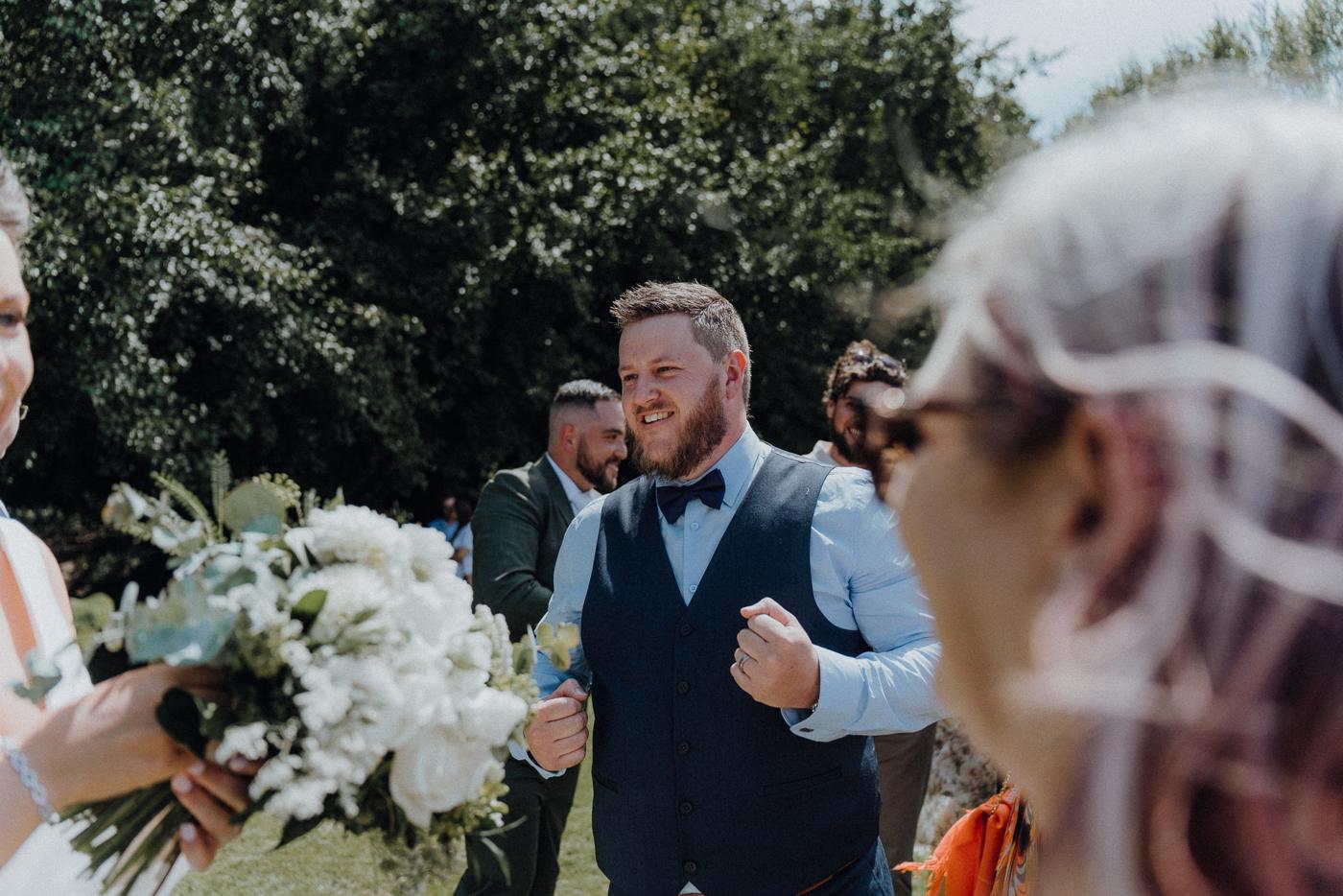
The directed hours: formals and portraits
This is the part that surprises couples who hear “documentary” and assume no posing at all. A documentary day still contains a family formals block and couple portraits. They are shot in a different way, and it is worth being clear about the difference.
Family formals are organised, fast and traditional. Someone has to call names and move people, and that part of the day is the photographer’s to run. Documentary work does not pretend otherwise. A written list of groups, handed over before the day, helps more than anything else, and a relative who can name everyone on it helps further. How much time family formals really need explains how to size the block.
Couple portraits are where gentle guidance comes in. The aim is not a rigid pose. The photographer gives a simple prompt, such as a direction to walk, a thing to say to each other or somewhere to stand, and then steps back so the result looks like the two of you rather than like a catalogue. If the camera makes you stiff, say so. Camera-shy couples are normal, and a good photographer plans around it rather than hoping it passes.
The reason this fits inside documentary coverage is simple. The directed blocks are short, they sit where the day needs them, and everything around them is left to happen. The mix of directed and unplanned is what the approach consists of.
The reception: speeches, the meal and the dance floor
Reception coverage is the clearest place to see documentary work, because it changes speed three times.
Speeches and the first dance are high value. A speech is a sequence of reactions that will not repeat: the person being talked about, the table that gets the joke, the one guest who starts to laugh a beat before everyone else. A photographer in a good spot, usually with a clear view of both the speaker and the people responding, can get all of it. Poor placement means photographs of the speaker only, which is the least interesting half.
Ask your venue and your MC about the order of events. If the speeches slip later than the schedule says, a short coverage window may end before they start, which is why the hours you book matter. Six hours usually ends before the speeches.
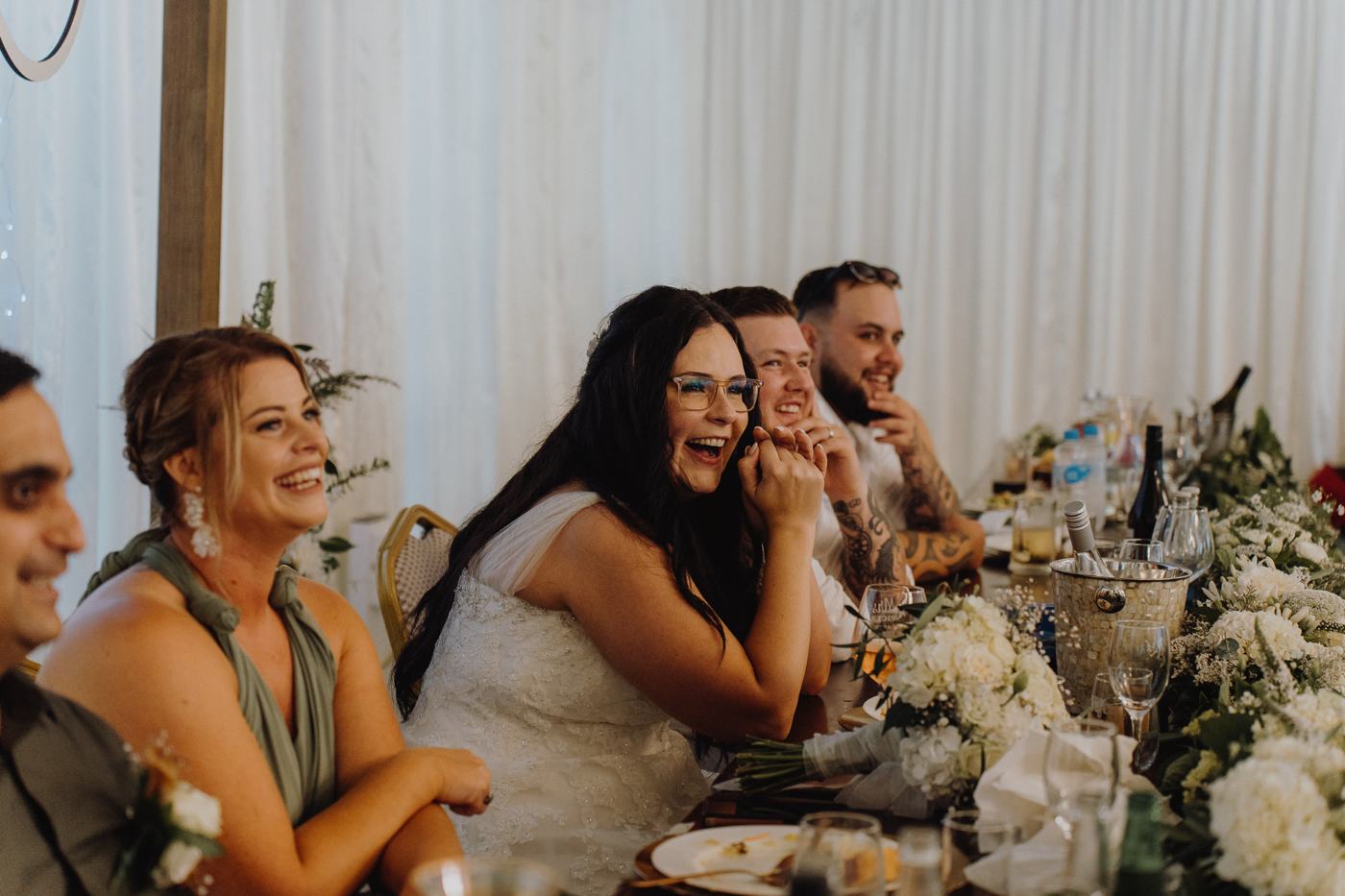
The meal is the quietest stretch of the day by design. A shutter clicking over someone mid-bite adds nothing to a gallery and makes a room self-conscious right when it should be relaxing. A good documentary photographer eases off, takes a few frames of the room and the tables, and saves their attention for what comes next. If you see very little coverage of dinner in a gallery, that is the style working, not a gap.
This is also the right time for the photographer to eat. Ask your caterer whether a meal is included for suppliers, and confirm it before the day. A photographer who has not eaten all day is slower for the dance floor.
Dancing is fast, loud and often dark. Light is low and mixed, people move quickly, and expressions last a fraction of a second. This is the stretch where documentary skill and equipment matter most, and where you want to look closely at a photographer’s reception work before booking.
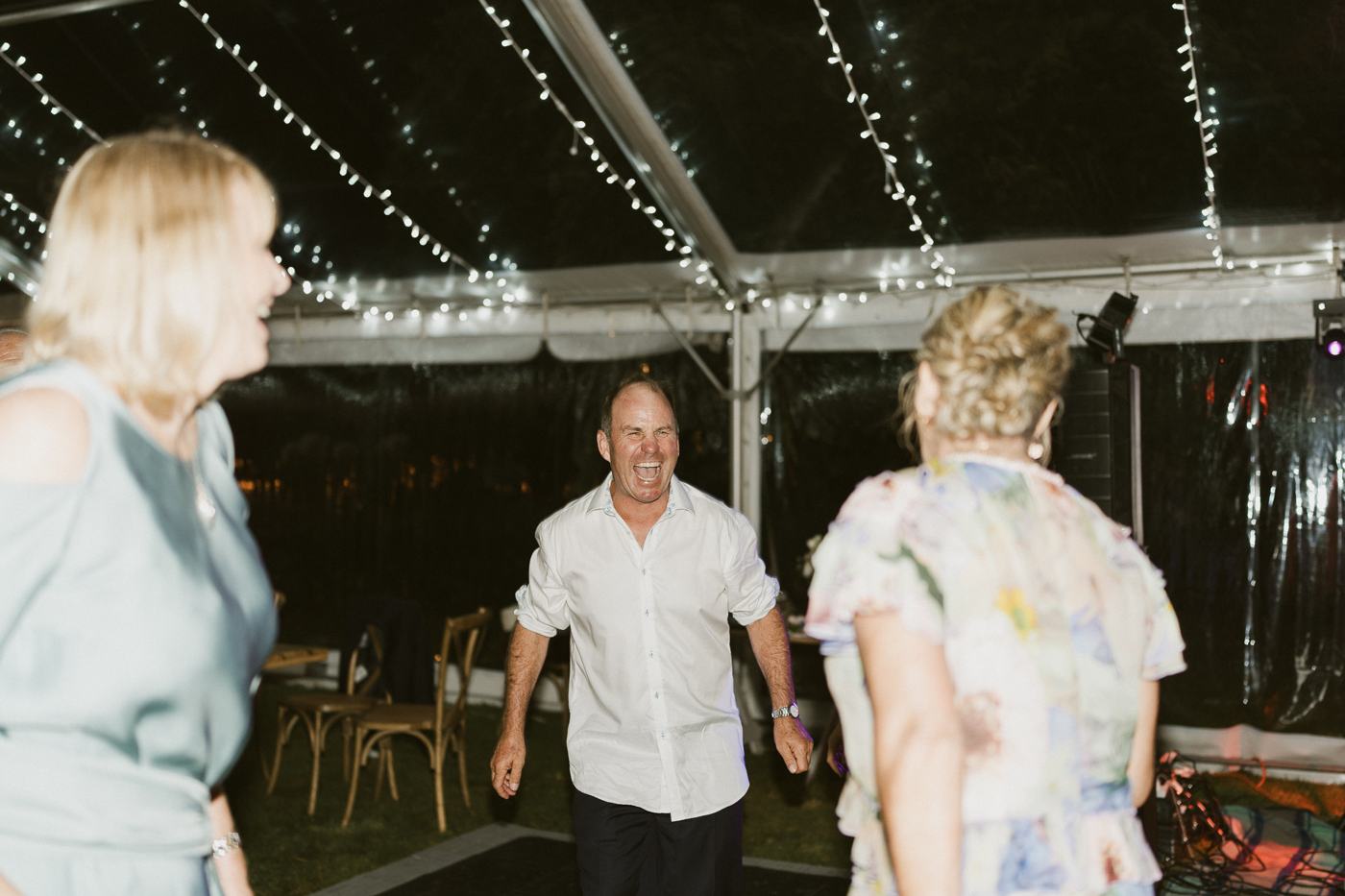
Where documentary coverage can go wrong
Documentary is not automatically better than other approaches. It has failure modes, and knowing them helps you check a photographer’s work.
Arriving late to moments. One weakness is a photographer who reacts rather than anticipates, and is always a beat behind. You can spot it in a gallery: plenty of frames just after the laugh, few of the laugh itself.
Shooting at a flat rate. If a gallery seems to treat the meal and the speeches as equal, the photographer may be filling the day rather than reading it.
Skipping the structure. Documentary coverage that ignores formals and portraits leaves you without the photographs your families will want on a wall. A good photographer guides these parts instead of avoiding them.
Going passive in a crowd. On a day with many guests, nobody is going to leave a gap for the photographer. Taking a position and keeping it takes decisiveness, and a photographer who waits to be invited ends up behind someone’s shoulder.
A full gallery shows most of this at once. How to read a full gallery instead of a highlight reel explains what to look at. Every TZ booking includes at least 300 edited high-resolution photographs, depending on hours.
Choosing what to protect if you book fewer hours
If you are choosing where to spend a shorter coverage block, there is a sensible order of priority, and it follows from the sections above.
- The ceremony and the stretch just after it. This window holds the vows, the reactions, the formals and usually the first portraits. It cannot be photographed at any other time.
- Getting ready. It is the next thing to keep, because it holds the pictures of people who will not appear again in the day.
- The speeches. If your coverage will end before them, think about whether you would be sorry not to have them.
- Late dancing. This is the first thing to let go, because dancing from earlier in the evening can already show the same energy.
The right answer depends on your own schedule. A day with a late ceremony and early speeches needs a different cut from a day where the speeches fall after dinner. Draw your day on a page and see where the line falls. The Your Day planner is a quick way to see the order of the day and where the light sits.
If your wedding is smaller or more low-key, the method does not change. The weight shifts toward the ceremony and portraits, with less on the reception, but the work is still to watch, anticipate and stay out of the way until a moment needs direction.
What to do next
- Write your own version of the table. Put your real times against the day and mark which parts matter most to you. That list shapes the hours you need.
- Ask to see a full gallery. Not a highlight reel. Look at the meal, the speeches and the dance floor, and see whether the coverage changes pace the way a documentary day should. The Gallery page shows four whole weddings.
- Ask how directed parts are handled. Ask any photographer how they run formals and portraits, and how they guide a camera-shy couple.
- Settle the ceremony rules early. Check with your celebrant and venue what the photographer may do, and decide on phones.
- Check hours and cost. Photography starts from $4,000, and hours, film and where you marry move the price from there. See how booking works.
If you would like to know whether your date is free and what the day could look like, check your date. If it is booked, you will hear that straight away.