Most couples book their photographer, venue and ceremony time 12 to 18 months before the wedding. That means the time on your contract was usually chosen in a different season from the day itself, often on a venue visit when the light looked wonderful. With daylight saving in Sydney, the two seasons can sit on opposite sides of a clock change.
That is where a daylight saving wedding in Sydney goes wrong. The venue hasn’t changed, but the clock has moved an hour and the days have lengthened or shortened. This guide shows how big the shift is, using computed Sydney light data, and how to set (or fix) a ceremony time so the light works for you.
Quick answer: Sydney’s daylight saving runs from the first Sunday in October to the first Sunday in April. Across that April changeover, the sunset in the 2027 data moves 101 minutes earlier between mid-March and mid-April. Check the sunset for your actual wedding date, not the date you toured the venue, and set your ceremony time by working back from it.
On this page
- Why a year out sets the trap
- What the clock change actually does
- The sharp end: weddings in April and June
- The opposite trap: spring and early summer
- Weddings near the changeover Sunday
- Setting the ceremony time: work back from sunset
- If your ceremony time is already booked
- Your venue’s horizon changes the number
- Questions to ask before you set the time
- What to do next
Why a year out sets the trap
A venue visit is a sample of one afternoon. You stand on the lawn at 6pm, the light is soft and low, and you picture your own ceremony right there. Then you book a time that feels like what you saw. Nobody in that moment checks which side of the clock change the visit and the wedding fall on.
Clocks and the sun are separate. The clock jumps one hour on a single Sunday. The sun keeps moving at its own pace, so the shift in sunset time is the clock change plus the normal seasonal drift. The two can add together or partly cancel.
Memory doesn’t carry a date. “It was gorgeous at six” sticks. “It was the middle of November” doesn’t. A venue’s photos online make this worse, because they show the best light from every season at once with no dates attached.
Contracts fix a time, not a light condition. Once a ceremony time is printed on a celebrant booking, a venue run sheet and an invitation, it feels permanent. The sunset will not move to suit it.
Say you toured a venue in November at 7:15pm. In the data below, golden hour on 15 November runs from 7:01pm to the 7:36pm sunset, so you saw the lawn in its best light. Book 7:15pm as the ceremony time for a wedding on 15 April (sunset 5:33pm), and you have booked a ceremony that starts 1 hour 42 minutes after sunset.
What the clock change actually does
Here are the sunset times for Sydney on the 15th of every month in 2027, with the start of golden hour (sun 6 degrees above the horizon) and civil dusk (sun 6 degrees below it). The data is for the Sydney CBD. Times are local, so they are on daylight saving where it applies.
| 15th of the month | Golden hour starts | Sunset | Civil dusk | Clock |
|---|---|---|---|---|
| January | 7:33pm | 8:09pm | 8:38pm | AEDT |
| February | 7:15pm | 7:48pm | 8:15pm | AEDT |
| March | 6:41pm | 7:14pm | 7:39pm | AEDT |
| April | 4:59pm | 5:33pm | 5:58pm | AEST |
| May | 4:27pm | 5:03pm | 5:30pm | AEST |
| June | 4:15pm | 4:53pm | 5:21pm | AEST |
| July | 4:27pm | 5:04pm | 5:31pm | AEST |
| August | 4:50pm | 5:25pm | 5:51pm | AEST |
| September | 5:13pm | 5:46pm | 6:11pm | AEST |
| October | 6:35pm | 7:08pm | 7:34pm | AEDT |
| November | 7:01pm | 7:36pm | 8:03pm | AEDT |
| December | 7:25pm | 8:02pm | 8:31pm | AEDT |
Two jumps stand out.
Between 15 March and 15 April, sunset moves from 7:14pm to 5:33pm, which is 101 minutes. About an hour of that is the clock going back. The remaining 41 minutes or so is the sun itself, because the days are getting shorter. So the change feels sharper than either effect alone.
Between 15 September and 15 October, sunset moves from 5:46pm to 7:08pm, which is 82 minutes. Here the clock goes forward and the days are lengthening, so again the two effects stack.
Look at the golden hour column as well. The usable golden window is a similar length all year (the data has it between 33 and 38 minutes). What changes is when it happens on the clock. For your ceremony and portraits, the clock time is what you plan around.
The dates the clocks change are set by government rules, so confirm the current changeover dates for your wedding year on the official NSW government site.
The sharp end: weddings in April and June
If your wedding is in April and you booked while picturing summer or early autumn, you are the highest-risk case on the table. Here is a worked example, clearly an example.
Say you visited on 15 February. Sunset was 7:48pm, golden hour started at 7:15pm. You loved the 7pm light and booked a 6pm ceremony for your wedding on 15 April, reasoning that you would still have some evening glow afterwards.
On 15 April, golden hour starts at 4:59pm, sunset is at 5:33pm and civil dusk is at 5:58pm. A 6pm ceremony starts after civil dusk. The family formals, couple portraits and any outdoor drinks would all fall in the dark or in venue lighting. The ceremony itself might be fine under the venue’s lights, but you will have lost the daylight portraits you pictured.
Autumn has a few traps of its own.
Afternoons feel generous. A bright 3pm in April can feel like a summer afternoon, so it is easy to think there is plenty of day left. On 15 April golden hour starts at 4:59pm, less than two hours later.
Vendors say “afternoon light” loosely. Ask for actual times.
Everyone else runs on the same clock. Guests arrive for the time on the invitation, so if you move the ceremony earlier to fix the light, tell them early.
The same logic runs through winter. In the 2027 data, June sunset is 4:53pm and civil dusk 5:21pm, so a late-afternoon winter ceremony finishes in the dusk. Our winter weddings article covers the shorter day.
The opposite trap: spring and early summer
The October jump gets less attention, but it catches couples the other way around.
Say you toured a venue in mid-September, when sunset was around 5:46pm (the 15 September figure). You judged that a 4pm ceremony would give good light and booked that time for a wedding on 15 October. The 15 October sunset is 7:08pm and golden hour starts at 6:35pm. A 4pm ceremony then sits in bright, high afternoon sun, and you will have a long gap between the ceremony and the sunset portraits. You haven’t lost the light. You have just placed the ceremony far from the best of it.
That sounds like the smaller problem, and it is, but it still costs you:
- Guests wait a long time between the ceremony and dinner, or portraits get squeezed between courses.
- Couple portraits happen in hard overhead light unless you pause the reception to go out at golden hour.
The remedy is the same as in autumn. Look up the sunset for your date, then choose the ceremony time on purpose. Either season works once you have picked the time deliberately.
Weddings near the changeover Sunday
If your wedding falls within a couple of weeks of either changeover, a monthly figure isn’t enough. Here are the 1st and 15th of April and October from the 2027 data. In 2027 the first Sunday of April and the first Sunday of October both sit between the two dates in each pair.
| Date | Sunrise | Golden hour starts | Sunset | Civil dusk | Clock |
|---|---|---|---|---|---|
| 1 April | 7:07am | 6:18pm | 6:51pm | 7:16pm | AEDT |
| 15 April | 6:17am | 4:59pm | 5:33pm | 5:58pm | AEST |
| 1 October | 5:33am | 5:24pm | 5:57pm | 6:22pm | AEST |
| 15 October | 6:15am | 6:35pm | 7:08pm | 7:34pm | AEDT |
In those two weeks of April, sunset moves 78 minutes earlier. In the two weeks of October, it moves 71 minutes later. So a wedding on 1 April and one on 15 April, both with a 5:30pm ceremony, would have completely different light.
The morning moves as well. Sunrise on 1 April is 7:07am, and on 15 April it is 6:17am. If you are getting ready at dawn or planning an early first look, that is a different clock time as well. Daylight saving is not only an evening issue. It is just most expensive in the evening.
Setting the ceremony time: work back from sunset
Once you know the sunset for your date, you can build a ceremony time with a simple method. It is a decision rule, not a formula, because every day has different pieces in it.
- Decide where you want your main portraits. If the best portraits for you are in golden hour, then golden hour is your anchor. If you would rather have softer, earlier light, or you care more about guests and food, the anchor moves.
- Work backwards from the golden hour start. Take the golden hour start time. Subtract the time you want for portraits before it if you want a longer session. Then subtract the time for family formals, and then the ceremony itself, and the walk or travel between them.
- Add a buffer. A ceremony that starts a bit late pushes everything. Leave room for that.
- Check the answer against the venue. A west-facing venue with a hill or tree line to the west loses direct sun earlier than the table suggests, so your usable light ends sooner.
Here is a worked example, labelled as an example. Say your wedding is on 15 April, golden hour starts at 4:59pm, and you want your couple portraits to begin at about that time. Say the ceremony lasts 30 minutes, 20 minutes of congratulations follow it, family formals take 30 minutes, and you want a 15 minute buffer. Working back, 95 minutes before 4:59pm puts the ceremony start at about 3:24pm, so call it a 3:25pm start. The numbers in this example are assumptions for illustration, so use your celebrant’s real length and your own list of formals. Our family formals article covers how long groups take.
A different answer, equally valid: keep a 5pm ceremony for the sunset feel, do family formals before it, and take a few minutes of dusk portraits right after. That is a trade-off, not a mistake.
If the day is complex, our Sydney wedding day timeline and the light planner on Your Day show how the pieces fit together.
If your ceremony time is already booked
If you have already printed invitations, you can still protect the light without moving the ceremony. These are the options, from least disruptive to most.
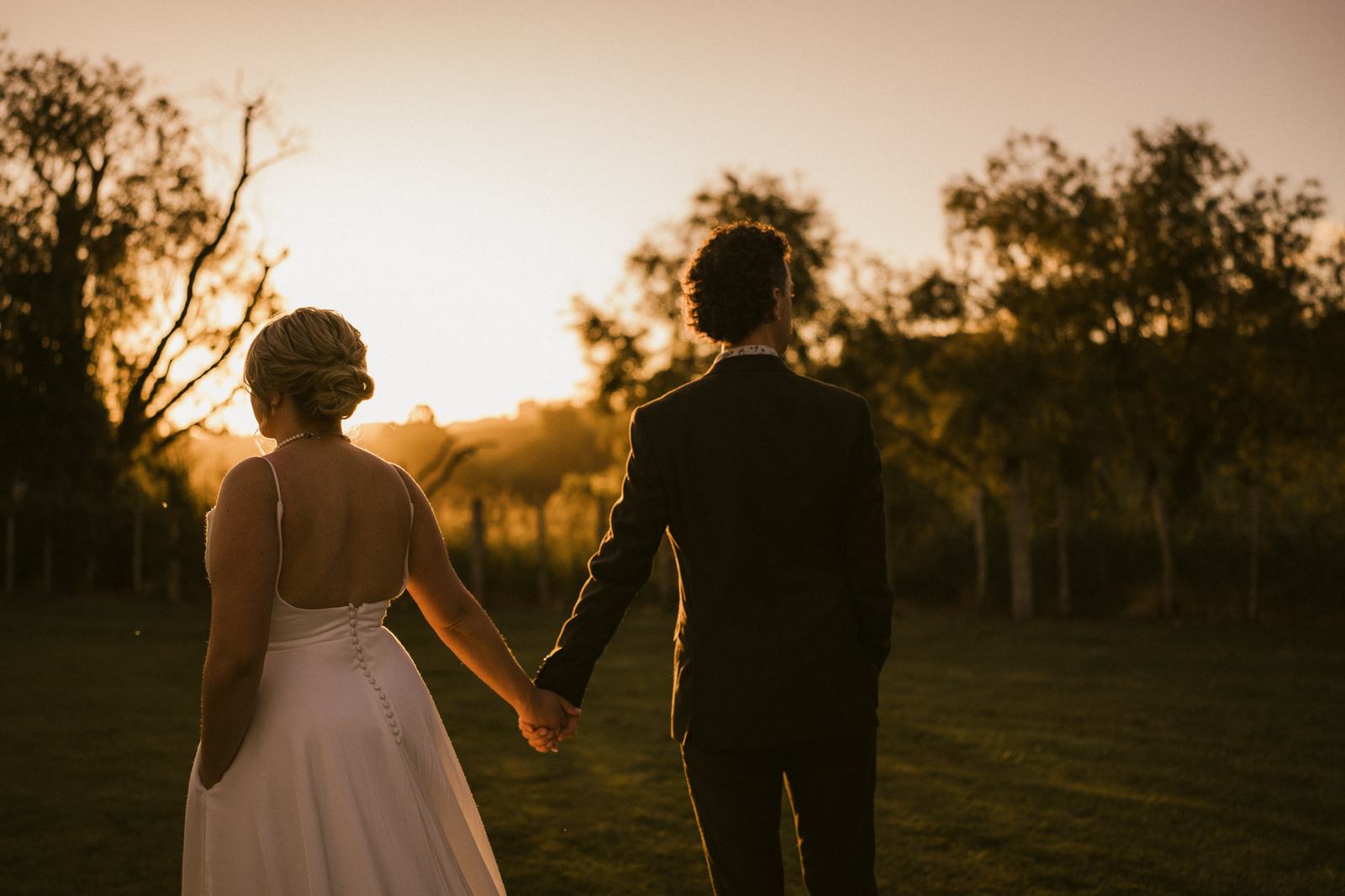
Do formals before the ceremony. If your ceremony is too late for golden hour, do the couple portraits earlier. A first look (seeing each other privately before the ceremony) lets you do that. Our first look article lays out what each choice does to your day.
Trim the family formals list. A shorter list means fewer minutes and a bigger chance of finishing in light. You choose who is on it.
Move the order of events. Sometimes the reception drinks can move before the ceremony, or the portraits can happen between the ceremony and the dinner.
Use dusk, not golden hour. If the ceremony ends after golden hour, civil dusk is still a short window of soft light. You will not have sun, but the sky can give you something good.
Move the ceremony. If the ceremony is the thing that is wrong, and you haven’t printed anything, then moving it costs the least. If you have printed invitations, a message to guests is a small price compared with losing the light.
Your venue’s horizon changes the number
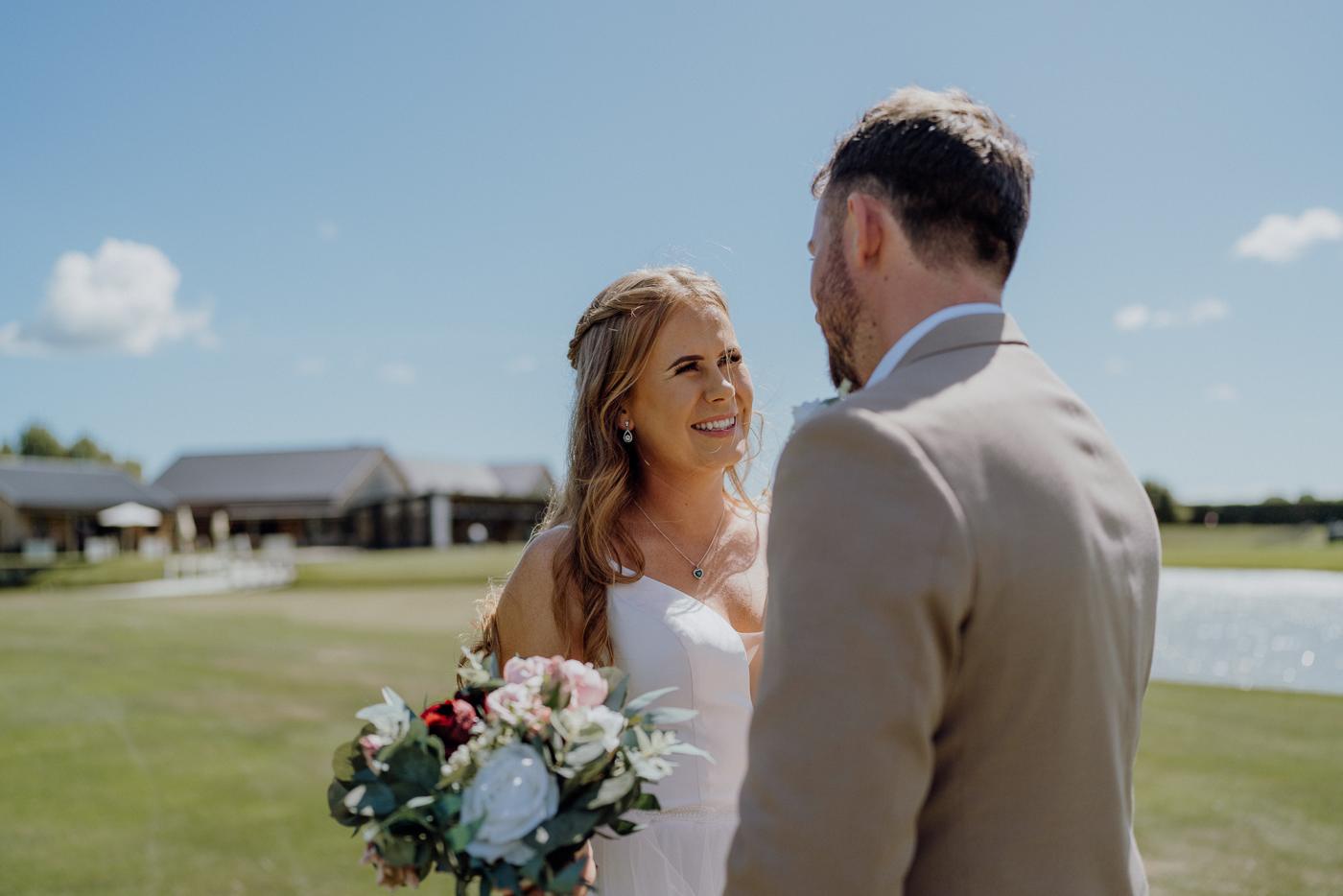
The sunset times above come from a computed figure for the Sydney CBD. They tell you when the sun reaches the horizon in theory. At an actual venue, a hill, a building or a line of trees to the west can cut the direct light earlier. A west-facing venue loses usable light before the table’s sunset time. Open water or flat ground lets you hold the light closer to it.
That matters most in autumn and winter, when the margin is already small. Harbour, beach and western Sydney venues can have different horizons on the same date. Our article on harbour, beach and west light explains how.
Ask the venue where the sun sets relative to the ceremony space, and visit at a similar time of year if you can. The Sydney golden hour by month article has month-by-month figures you can build a timeline on.
Questions to ask before you set the time
Take these to your venue, celebrant and photographer. They turn a vague “afternoon light” into a plan.
For your venue:
- Which direction does the ceremony space face, and where does the sun set relative to it on my date?
- When does the ceremony space fall into shade on that date, and when do you turn the lights on?
- Is there an indoor option with good window light if the outdoor time is late?
For your celebrant:
- How long does the ceremony run from the first guest seated to the signing?
- Can the ceremony time be set to a minute, rather than a rough hour?
For your photographer:
- What time is golden hour and civil dusk on my date, and where does my ceremony time land against them?
- If my ceremony is late for the light, what do you suggest we do before and after it?
- When do you need the ceremony time confirmed, so the plan can still change?
A photographer who answers these straight away is worth keeping. Binh answers honestly whether he is free on a date.
What to do next
- Write down the actual date of your wedding and look up its sunset, golden hour start and civil dusk. Use the tables above if it is a 2027 date, and check the official source for your year.
- Compare that to your ceremony time. Is the ceremony before, during or after golden hour? Does the plan you have in mind match the light?
- Decide what matters most for your portraits, and use the work-back method to set or confirm the time. Then check it against the venue’s horizon.
- Tell your celebrant, venue and guests about any change as early as you can, before invitations are printed if possible.
- Send us your date and ceremony time through the contact page, and see the investment page if you are weighing hours and price. Our tips library has the rest of the planning guides.
If you have a date and a ceremony time, send them over and Binh will tell you whether the date is free and, if it is, what the day could look like.