
Plenty of people say it before they have even booked: “We’re not photogenic.” Or, said with a sigh, “he hates having his photo taken.” If that is you, camera shy wedding photos probably feel like the one part of the day you would happily skip.
Here is the good news. Looking stiff in a photo is rarely a fault in your face. It usually comes from being asked to stand still, smile on cue and be judged on the result, with no time to settle. Change those conditions and the same person looks like themselves. Camera-shy couples are normal, and a good photographer plans for it rather than being surprised by it.
Quick answer: Looking natural comes from giving your attention somewhere else, not from being told to relax. A small task, a bit of conversation and enough time for the first stiff expression to pass will do more than any pose. Nobody looks like themselves in frame one, and the first few frames are the warm-up, not the verdict.
On this page
- Why “just relax” makes it worse
- Give your hands and feet a job
- Frame one is never the keeper
- Laughter loosens a face faster than “smile”
- When it is quiet rather than funny
- Most of your day is not posed
- Before the day: practise being photographed, not posing
- Questions to ask your photographer
- Mistakes that make camera-shy photos worse
- What to do next
Why “just relax” makes it worse
Telling someone to relax in front of a camera is a bit like telling them to fall asleep on command. The instruction itself makes the thing harder, because now they are watching themselves try.
Here is the mechanism. When a lens points at you, part of your brain starts running a commentary: what is my face doing, are my hands weird, is my smile too big. That commentary is the stiffness. Shoulders lift, the jaw sets, the smile gets held a beat too long, and the eyes do that slightly wide thing eyes do when they know they are being watched. It is attention pointed at yourself, not a character flaw.
You cannot switch that commentary off by willpower. You can only give your attention a better job. Once your mind is busy with something real (walking, listening, fixing a collar, laughing at something) the commentary quiets down on its own, and the face goes back to how it looks when you are not performing.
That one idea sits underneath everything else in this article. Every technique below is a different way of moving your attention off “how do I look” and onto something else.
Give your hands and feet a job
A pose asks you to hold still and look good. A task asks you to do something, and the photo happens while you do it. The second is far easier to live inside.
Some tasks that work well for couples who dislike the camera:
- Walk slowly toward the photographer and talk about where you first met.
- Walk away together, then look back at your partner when you feel like it.
- Fix your partner’s collar, tie or the hem of a dress.
- Hold the flowers while your partner adjusts a shoe.
- Whisper something in your partner’s ear (it can be rude, as long as it is quiet).
- Hold hands and swing them a little, as if you were crossing a car park.
None of these is a pose. Each one gives you an action with a start and an end, and the camera records the middle. This is also why a simple prompt beats an elaborate one. “Walk and talk” is easy to follow. A five-part instruction about chin, shoulder and hip makes you think about your body, which is the opposite of the goal. Simple prompts and never over-posing is how portraits should work for a nervous couple.
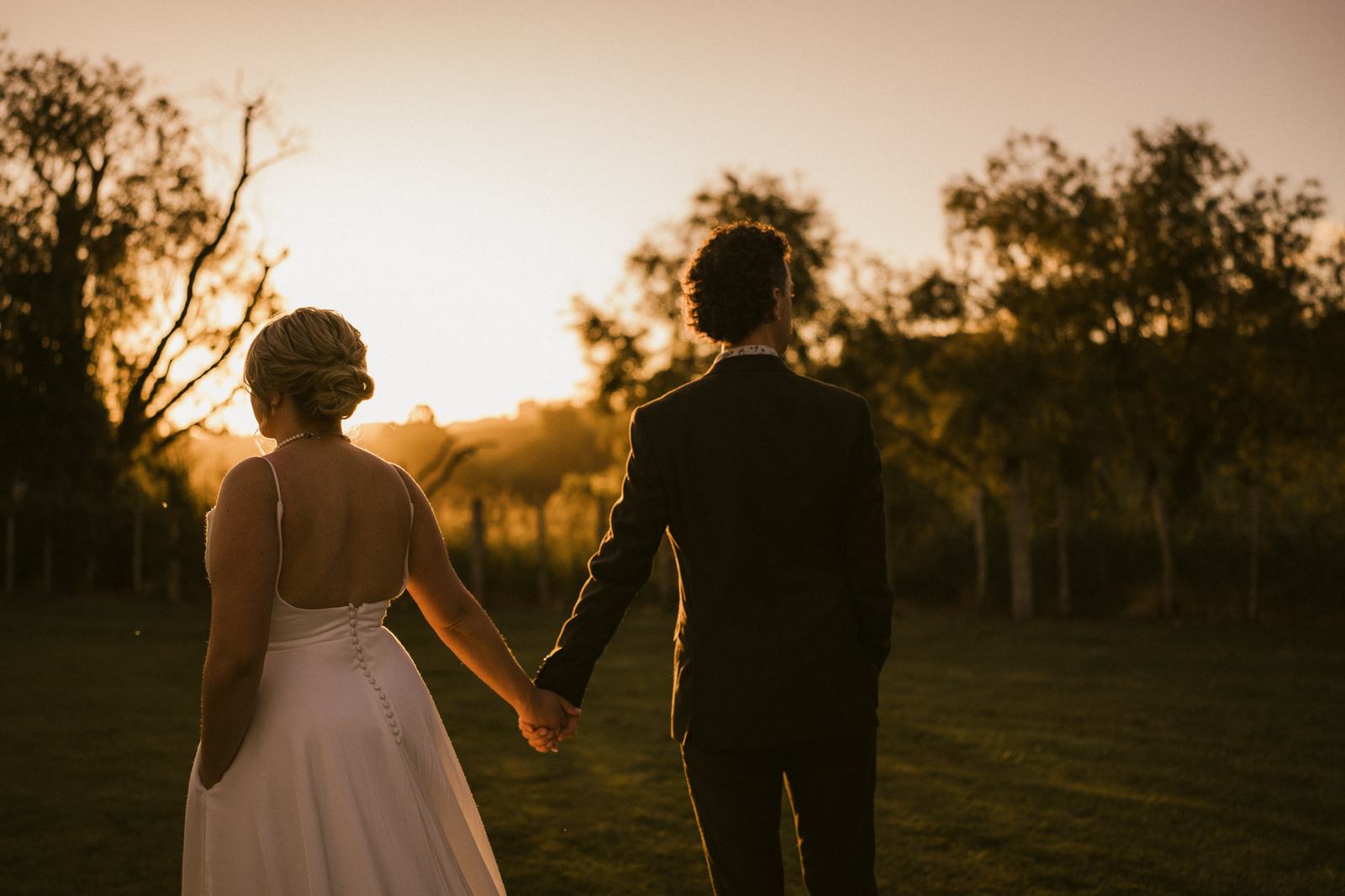
A task has another advantage for the person who says they hate this. It gives them a reason to be there that has nothing to do with the photograph. Someone who has set their jaw and announced that they don’t do this can be handed something useful instead, such as holding a veil off the grass or sorting a stuck hem. Being useful gives the mind a better job than being encouraged does, and the frames that come out of it are often ones where nobody is looking at the lens at all.
Reassurance, by contrast, backfires. “Loosen up, you’re doing great” is just the relax instruction in a friendlier voice. It tells the person they are the problem, and now they are watching someone manage them. If you are the partner of someone camera-shy, resist the urge to coach. Give them a job and talk about something else.
Frame one is never the keeper
Every portrait set has a warm-up. The first stretch of frames is usually the stiffest, because that is when you are most aware of being photographed. If the photographer stops at that point, that is the only version of you that exists.
If they keep going past the point where it feels awkward, the stiffness runs out. It does not run out because you got better at posing. It runs out because holding tension is tiring, and your face eventually gives up and goes back to normal. The photographer has to be willing to keep shooting through the awkward part, and has to have the time in the schedule to do it.
This is the single most useful thing to check in your own planning: how much time has been set aside for the two of you? The answer varies by day, venue and how many other things are packed around it, so there is no magic number. What matters is that the time is real and not squeezed between family formals and the cake. Ask your photographer how long they would like for your portraits and what they will do if the day runs late. If the honest answer is “whatever is left over”, that is the thing to fix before anything else on this page, because every other technique here needs time to work.
The same logic applies to light. Soft, low-angled light is kinder to a tense face because there is less squinting and less hard shadow to fight. If your timeline can put portraits in the warm light before sunset instead of at midday, your face has one less thing to cope with. The golden hour guide shows how much of that light you get at different times of the year.
A photographer who understands this also keeps talking. Silence from behind a camera reads as judgement, so a running commentary (“good, do that again”, “turn your head a touch”) tells you that you are not failing at something invisible. And a short break with the camera down, just talking about nothing, resets the tension that builds up over a long run of continuous shooting.
Laughter loosens a face faster than “smile”
Ask someone to smile and you get the smile they use for passport photos. Ask them to laugh at something that is actually funny and the whole face changes: the eyes crinkle, the shoulders drop, the mouth does something asymmetrical and human.
So a good approach to a camera-shy couple is to get a real laugh early, before worrying about eye contact with the lens. It usually only takes one decent joke, or one deliberately terrible one. A photographer can supply that, but you can also bring your own. Decide in advance what makes your partner laugh: a private reference, a nickname, a story from a bad holiday. Tell the photographer, or just say it aloud when you are in front of the camera.
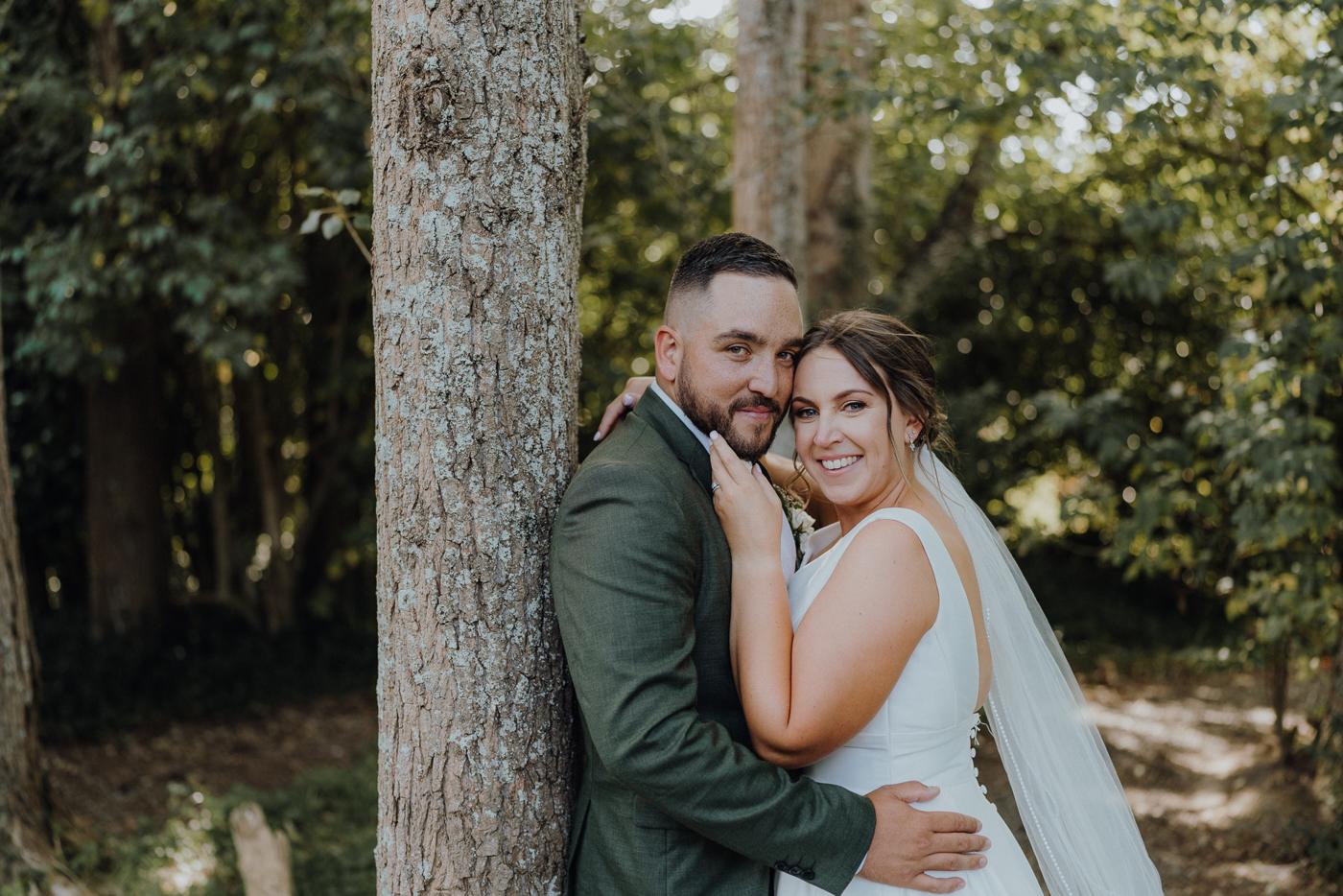
One caution: forced laughter is worse than a plain serious expression. If the joke lands badly, let it fall flat and move on. A calm, slightly serious face is perfectly good, and it often photographs better than a strained grin.
When it is quiet rather than funny
Not every couple wants to laugh through their portraits, and not every good frame is a laughing one. Some of the best images from a camera-shy couple are the quiet ones: foreheads together, eyes closed, no performance at all.
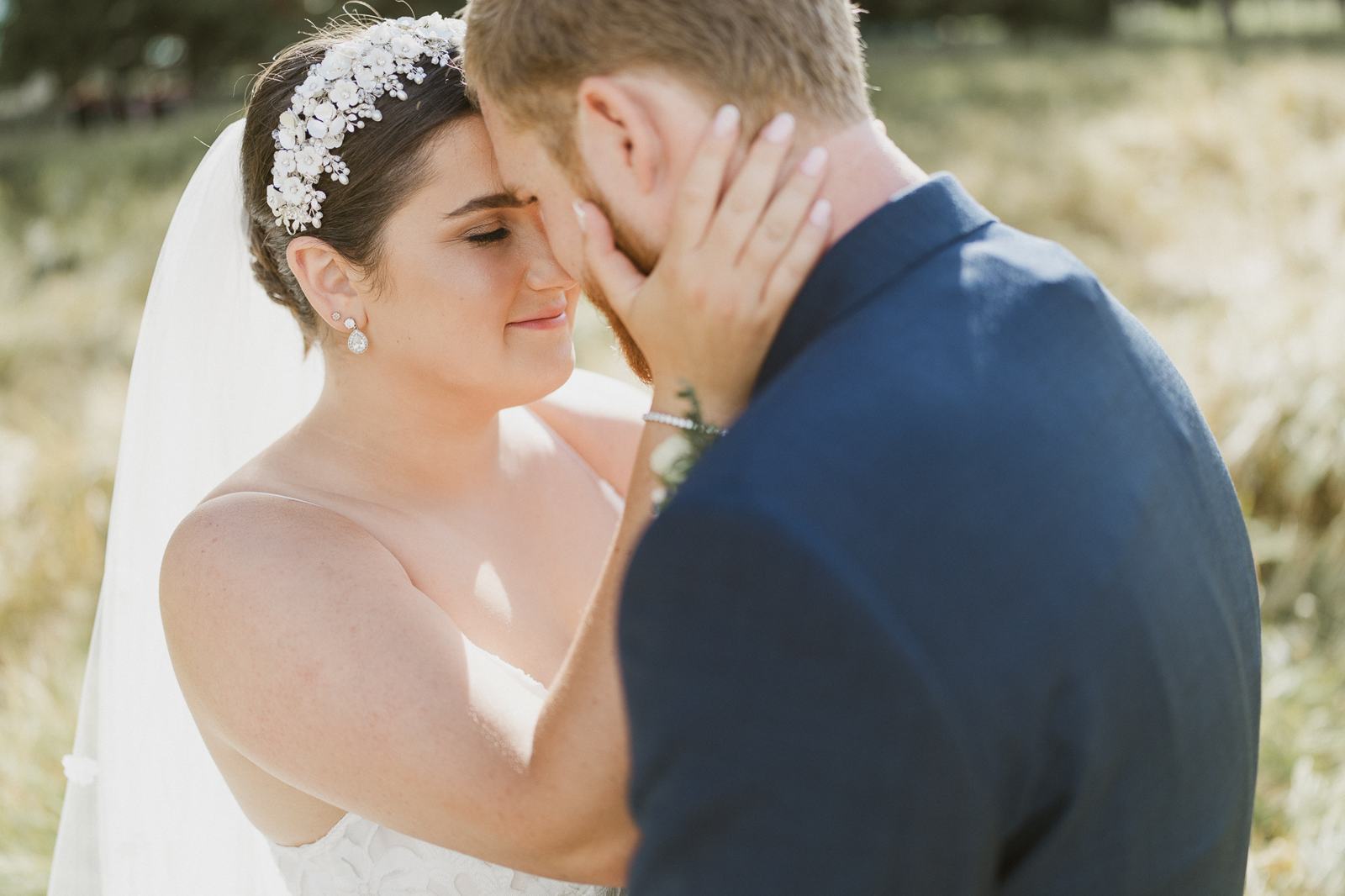
This is a useful trick for anyone who finds eye contact with the camera the hardest part. If your eyes are closed, or fixed on your partner, the lens does not need an expression from you. Closeness is a task too. Standing forehead to forehead, breathing slowly and being quiet for a few seconds is hard to fake and easy to do.
A few other low-pressure options:
- Look at your partner instead of the camera for most of the set.
- Look down and away, as if reading something on the ground.
- Turn your back to the lens and walk off together.
- Stand close enough that your faces are partly hidden, and let the shoulder and hair carry the picture.
Most of your day is not posed
The anxiety about not being photogenic is usually about the portrait session specifically, because that is the part where you know you are being photographed and cannot get around it. The rest of a documentary-style day is different. Getting ready, the ceremony, the toasts and the dance floor are mostly things that happen whether or not a camera is there, and the photographer’s job in those hours is to be quietly out of the way. The gallery then contains a lot of moments you were not posing for at all. For many shy people that changes how the portrait session feels: it is a short, defined part of the day, not the whole of it.
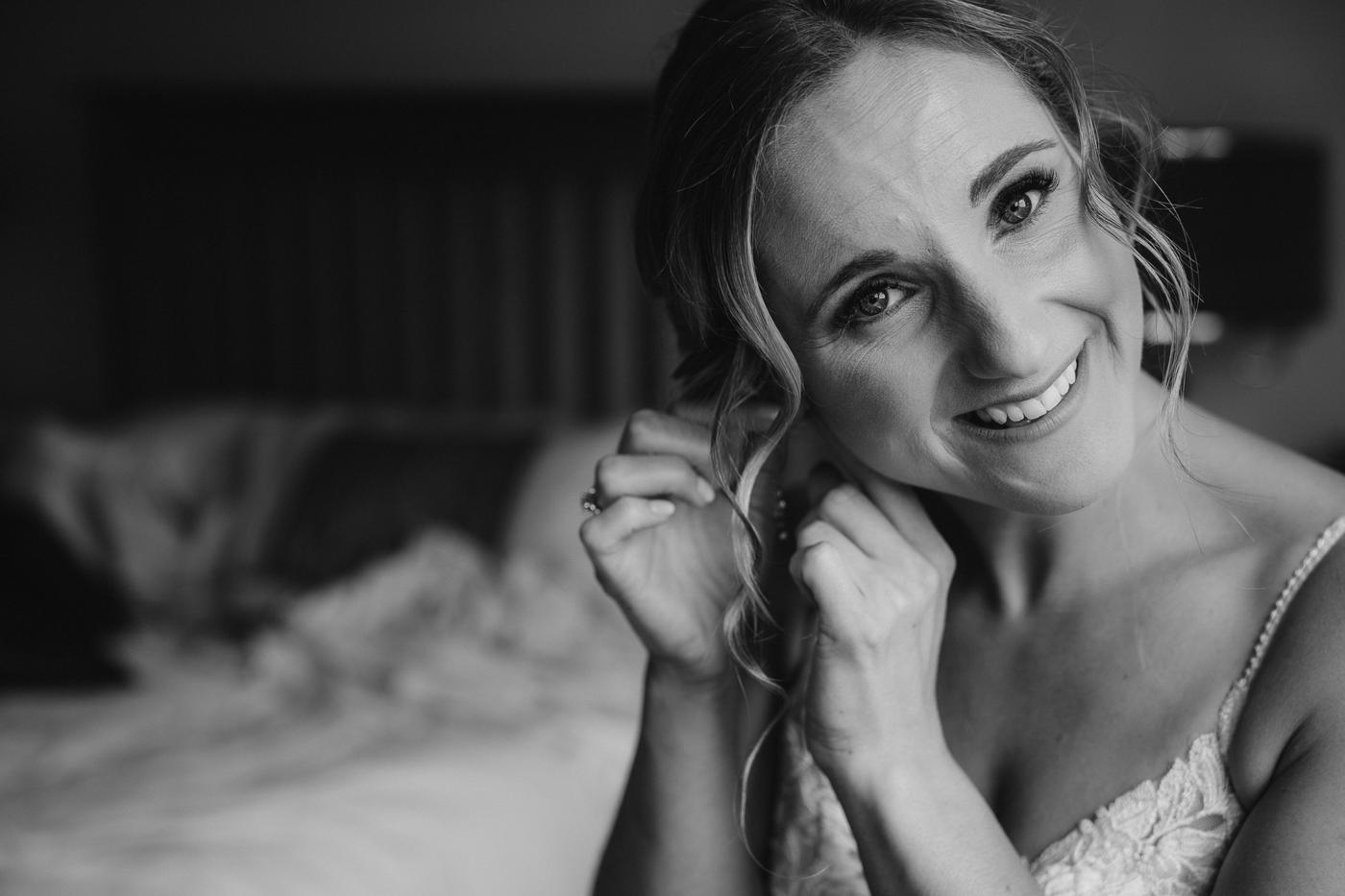
Real moments as they happen, with gentle guidance for portraits, is the way the day is photographed at TZ. If you want a sense of how that plays out over a whole day, the hour-by-hour look at documentary coverage is a good place to start. And if you are unsure which approach suits you, documentary, editorial or traditional lays out what each style asks of you.
Fine art for the quiet moments and quick hands for the loud ones means that, outside the portrait session, your job is simply to be present while the camera follows what happens.
Before the day: practise being photographed, not posing
You cannot rehearse your way out of self-consciousness by learning poses. Standing in front of a mirror and practising your smile tends to make you more aware of your face, not less. What does help is getting used to the experience of being photographed by someone, which is most of what people are actually nervous about.
Here is what is useful to do ahead of time:
- Book a pre-wedding session if you can. Pre-wedding sessions are offered, and a session of walking around with a photographer gives you a trial run of the warm-up described above. The first frames will be stiff, and that is useful to know in advance. By the end you will have seen what your own relaxed face looks like, and you will turn up on the day knowing what to expect.
- Look at full galleries, not highlight reels. Seeing the whole run of frames from a real wedding shows you that the awkward ones are a normal stage, not a verdict. The guide to reading a full wedding gallery explains what to look for.
- Tell your photographer what you dislike. If you hate your left side, hate being told to smile, or freeze when strangers watch, say so early. It is information, not a complaint.
- Agree a quiet signal. A word or a hand squeeze with your partner that means “I need a minute” gives you control, and control is calming.
- Look after the basics on the day. Eat something, drink water and wear shoes you can walk in. Hunger and sore feet show up on faces faster than anything else.
Questions to ask your photographer
If you are choosing a photographer and camera shyness is a worry, these are better than “do you have experience with shy couples?” because they make the answer specific:
| Ask this | What a good answer sounds like |
|---|---|
| How do you get a nervous couple to relax? | Something concrete involving tasks, conversation or movement, not “I just make them feel comfortable” |
| How much time do you want for our portraits? | A real window that can be protected, plus what happens if the day runs late |
| What do you do when the first frames are stiff? | They keep shooting and keep talking, and do not rush |
| Do you pose us in detail? | Simple prompts, not a long list of body instructions |
| Can we do a session before the wedding? | Yes, or a clear reason why not |
| What will you do if one of us really freezes? | A plan that changes the task, the place or the pace |
You will learn more from the way they answer than from the answer itself. Someone who talks easily and specifically about what they do with an anxious person has thought about it. Someone who falls back on “everyone loves my photos” has not thought about it. The questions worth asking before you book has a fuller list for the other parts of the decision.
Mistakes that make camera-shy photos worse
Each of these has a cause, and knowing the cause makes the fix obvious.
Rehearsing a smile. A practised smile is a held smile, and held smiles look held. The cause is attention on the face. Fix: laugh at something or look at your partner.
Staring into the lens the whole time. Eye contact with a camera is the hardest thing to do naturally, because the lens does not react. Fix: look at your partner for most of it and look at the camera only when it feels right.
Squeezing portraits into a gap. The cause is a timeline with no slack, and you feel the rush in your shoulders. Fix: protect the time before the day, and ask your photographer what they need.
Stopping at the first stiff set. If you or the photographer decide “this isn’t working” after the first stretch, you never reach the loose frames. Fix: keep going and let the stiffness run out.
Having a crowd watching. Portrait time with a ring of family looking on makes anyone self-conscious. Fix: ask for the two of you to go somewhere quiet, and have the family wait elsewhere. If group shots are the stressor, what photographers wish you knew about group shots explains how to keep them short and calm.
Treating a bad first minute as proof. One awkward stretch does not mean you are unphotogenic. It means you are a normal person at the start of a portrait set.
What to do next
- Decide how much you want to be photographed at all. If portraits are the part you dread, say so, and plan more of the day around moments rather than set-ups.
- Ask any photographer you are considering the questions in the table above, and notice whether the answers are specific.
- Look at a few full galleries (including the gallery of four whole weddings) to see how the awkward and the natural frames sit side by side.
- Check the order of the day and light planner so portraits land in kind light with slack around them.
- If you want a trial run, ask about a pre-wedding session, and read what it costs and how booking works. Photography starts from $4,000, and hours, film and where you marry move the price from there.
If you genuinely dread being photographed, get in touch and say so up front. You will hear honestly whether your date is free, and what the day could look like around your shyness.