
A wedding that runs late has often been decided before the ceremony starts, during getting ready. The morning is where small delays stack up, and almost none of them are anyone’s fault. They happen because the parts of the morning that take longer than planned were never given room in the schedule.
This is a guide to building a realistic wedding getting ready timeline: where the minutes go, how much buffer to add, what a drifting morning looks like on paper, and what the drift costs you later when the light starts to fade.
Quick answer: Add a flat 30 minutes to whatever your hair and makeup artist quotes you, and another 15 to 20 minutes for the final dress or suit and the photos before you leave. Getting ready is the one block of the day with no hard deadline pulling it back into line, which is why it is the block that drifts.
On this page
- Why this block drifts when the others do not
- Where the minutes go
- How much buffer to add
- A morning that drifted, minute by minute
- What the drift costs later in the day
- When a buffer is not enough
- Put one person in charge of the clock
- Questions to ask before the morning
- The groom’s side, a small bridal party, and two locations
- What to do next
Why this block drifts when the others do not
Most blocks of a wedding day have something outside your control holding them in place. The ceremony starts at a time agreed with your celebrant and your guests. The reception follows the venue’s running order. Sunset arrives with or without you.
Getting ready has none of that. It ends when the room decides to leave, and the room is full of people who are, quite reasonably, not watching the clock the way your timeline needs them to. The artist is focused on the face in front of them, not the schedule three chairs down the line. Family are relaxed and chatting, which is exactly the mood you want on the morning of your wedding. It is also the mood that wears a timeline down five minutes at a time.
So the drift is not a character flaw in anyone present. It is what a block without a deadline does. The fix is to give it an artificial deadline (a departure time written down and owned by someone), and to put slack in front of that deadline so the first small delay does not eat it.
Where the minutes go
Four things tend to take the time, and none of them looks dramatic on its own.
Hair and makeup runs behind its own quote. A quote assumes each person takes about the average. Real mornings include a look that needs a second go, hair that behaves differently from the trial, a touch-up nobody planned. The quote is an estimate for a sequence of people, and a sequence only has to slip once for everyone after that point to slip too.
Getting into the dress or suit takes longer than the schedule says. A gown with buttons or lacing is a two-person job and often gets pencilled in as a quick step. A tie, cufflinks and a jacket that needs adjusting are quicker, but they still sit at the very end of the morning, where there is nowhere left to absorb them.
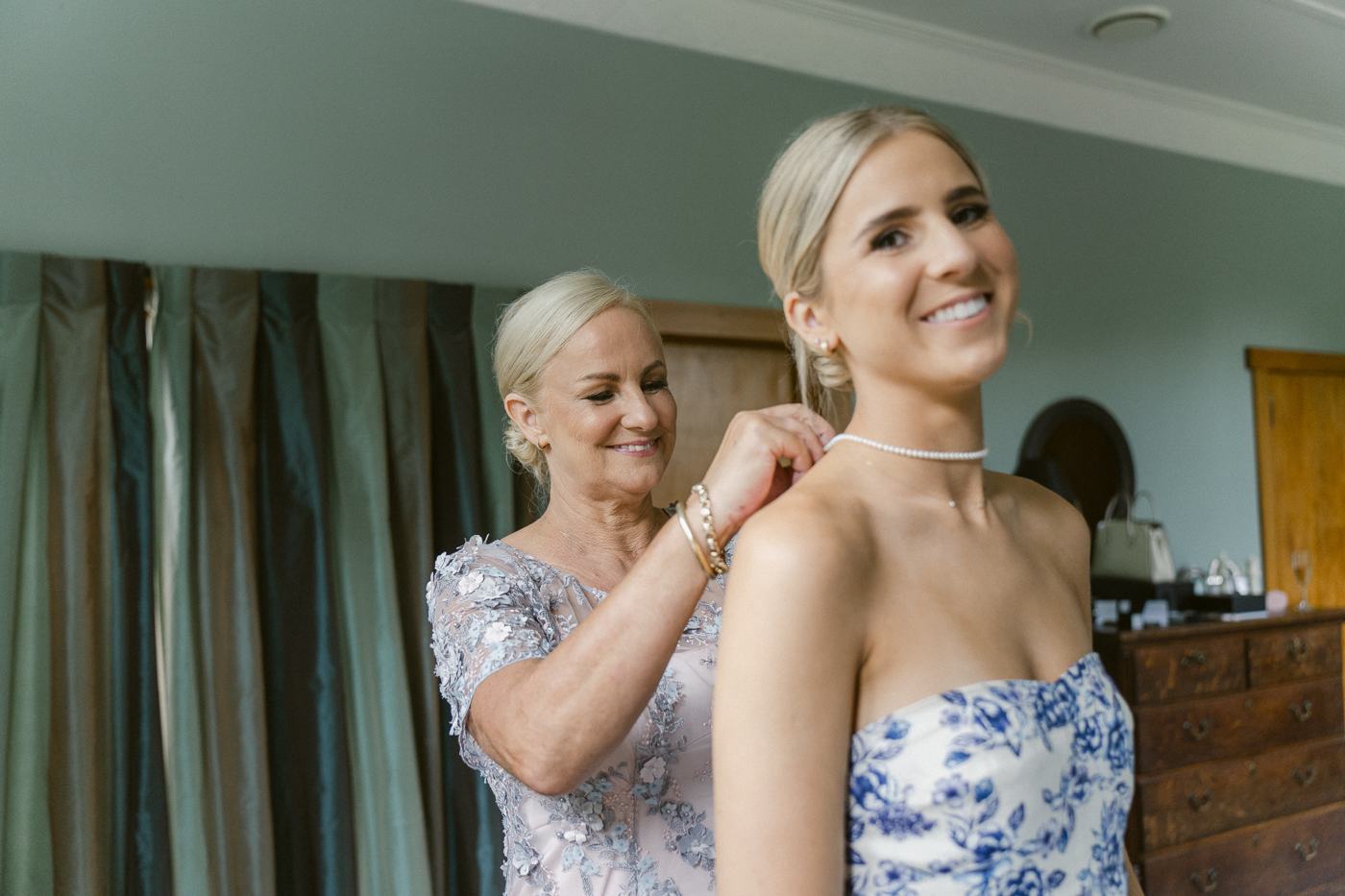
“A few quick photos before we go” grows. Photos of the dress on its hanger, the shoes, the rings, the veil, and the people you love fussing over you are often pictures people treasure. They also happen at the exact moment everyone is trying to leave, and they are rarely rushed well. Plan for them as a block of their own rather than hoping they fit into a gap.
Somebody has to go back for something. A boutonniere left on a kitchen bench, an earring in the wrong bag, a car that is not where it was meant to be. Any one of these is small. Two of them in one morning is a real delay.
How much buffer to add
The numbers below are a planning suggestion, not a measurement. They are sized to absorb a normal amount of drift without turning the morning into a long wait.
| What you are told | What to plan |
|---|---|
| Hair and makeup quote | Add 30 minutes on top |
| Final dress or suit and a few photos before leaving | Add 15 to 20 minutes on top |
| “We will be ready by X” | Treat X as 20 minutes before you actually need to leave |
| Travel between two getting-ready locations | Add it as its own line, with its own cushion |
Taken together, that is roughly an hour of slack across the whole block. It feels generous when you are writing the schedule at your kitchen table. If the morning runs smoothly, the buffer turns into a calm half hour with a glass of something and your people around you, which is hardly a loss.
Two things make the buffer work better.
First, write two times next to each other: the time you hope to leave and the time you must leave. Share the second one with the people who have to hit it, and keep the first one for your own head. Artists, bridesmaids and parents all work to the time they are given.
Second, put the buffer at the end of the sequence, not the start. A cushion at the start gets used up by the first late arrival and leaves nothing for the dress, which sits last in the chain and has no one behind it to catch it.
A morning that drifted, minute by minute
Here is what the stacking looks like on paper. This is an example built to show the pattern, with sizes chosen for the sake of the example, not a report of any one wedding.
Say hair and makeup is quoted to finish at 12:30pm, for a 1pm departure to a 2pm ceremony. The bride and four bridesmaids are being done by one artist in sequence. The plan allows ten minutes for the dress, five for photos, and has the car leaving at 1pm.
Now add the small, defensible delays. The second bridesmaid’s makeup needs redoing and one set of hair runs long, which together cost twenty minutes, so the bride, going last, is finished at 12:50pm, not 12:30pm. The dress, a fitted gown with lacing, takes eighteen minutes with two people helping. The “quick” photos run twelve minutes because the details are lovely and nobody wants to hurry them. One bridesmaid goes back for a forgotten bouquet, which is five more.
Add it up (12:50pm, then 18 minutes, 12 minutes and 5 minutes) and the group walks out at 1:25pm, twenty-five minutes behind the plan. None of those delays was a mistake. Every one was reasonable on its own, which is why the drift goes unnoticed: nobody sees the total until it is over.
Now run the same morning with the buffer. The artist starts earlier so the quote finishes at noon, and the car is still booked for 1pm. The same delays happen. The bride is done at 12:20pm, and with the dress, photos and bouquet the group is ready at 12:55pm and leaves on time, with five minutes to spare. The delays did not shrink. They had somewhere to land.
What the drift costs later in the day
A late morning does not stay in the morning. It passes down the timeline like a queue of cars, and it can arrive at the part of the day that has a real deadline: the light.
Here is one worked example for a single date, so you can see the shape of it. Say your wedding is on 15 June 2027 in Sydney. For that date, golden hour starts at 4:15pm, sunset is at 4:53pm and civil dusk is at 5:21pm. Golden hour that day is about 38 minutes long. After civil dusk, the usable light has run out.
Suppose you planned a 2pm ceremony, formal family photos straight after, then couple portraits from 4pm so that you are outside as golden hour approaches at 4:15pm. Now say the half hour lost in the morning carries through, and the family photos then run twenty minutes over. The couple portraits meant for 4pm begin around 4:50pm, three minutes before sunset. The warm, low light you planned around has come and gone while the group photos were still running.
The fix in a case like this is not to rush the portraits. It is to decide, ahead of time, which part of the afternoon gives way when the morning is late, and to say so to the people who will be affected. That could mean a shorter set of family groups, or a short portrait session before the family photos instead of after them. Your photographer can help you choose, and the choice is much easier to make at your desk months out than in a car park at 4pm.
If your date is in another month, the Sydney golden hour table in Sydney Golden Hour by Month gives you the times to build around, and The Sydney Wedding Day Timeline shows where the morning sits in the whole day. Winter makes this harder because there is less daylight to spend, which is covered in Winter Weddings in Sydney.
When a buffer is not enough
A 30-minute cushion fixes normal drift, the kind in the example above. It does not fix a plan that was too tight from the start. Some warning signs:
- Several people need full hair and makeup, and a single artist is working through them one after another with only a short window.
- A dress with a lengthy lacing or button process is scheduled with no time allowed for it.
- The group is getting ready at one location and the ceremony is a long drive away, with nothing added for parking, traffic or a missed turn.
- The artist’s quote is already running into your departure time before any delay happens.
In those cases the honest advice is not “add a buffer”. It is “change the plan”. That might mean starting earlier, asking the artist whether a second artist is possible for the larger group, trimming the number of people who need a full look, or building the dress’s real time into the schedule rather than treating it as a patch. A buffer absorbs the unexpected. It cannot create time that was never allocated.
Put one person in charge of the clock
The cheapest fix is a person. Choose someone in the room whose only job is watching the time and calling it out. Not you, and not a parent who is also getting ready. A friend or a sibling with a phone timer works well.
It helps because “we need to be dressed by 11:30” lands differently from a calm outsider than from a stressed parent or from you. A written schedule does not speak up in the room. A person does. Give them the two times from the table above, the hoped-for time and the real one, and ask them to call time at the half-way mark and again twenty minutes before the car.
Your photographer can mention the clock, but the room needs its own timekeeper, because a photographer who is busy keeping an eye on the schedule is not photographing the morning. Their job during this block is to photograph the quiet moments as they happen, and the timekeeper’s job is to protect the departure time. It is better for both jobs to belong to different people.

Questions to ask before the morning
Most of the work of a good morning happens in the weeks before it. These are the questions worth putting to the people involved.
To your hair and makeup artist:
- How long does each person in our group take, including me, and in what order should we go?
- What time do you need to start, and what is your latest finish?
- If something runs over, what do you do to catch up?
- Is a second artist possible for a larger group, and what does it change?
To your photographer:
- What time do you need to be at the getting-ready location, and which moments do you want to see?
- How much time do you need for the dress and detail photos, and where should they be done?
- Does the plan have room for the buffer, and where would you cut if we run late?
- If we are getting ready in two places, how do you cover both?
To your venue and transport:
- What time can we arrive, and is there a place to wait if we are early?
- Where do we park, and how long does that take on a weekend?
- Is there a hard finish on the ceremony space that makes a late start expensive?
The groom’s side, a small bridal party, and two locations
The groom’s side. A suit and simpler grooming take less time, so the buffer can be shorter. It still deserves a number. “Popping out for a few photos with the boys” has its own way of using twenty minutes, and the groom’s morning often depends on a car, a collection or a shared lift that has its own schedule.
A small bridal party. Fewer people lowers the risk without removing it. One unexpected dress adjustment or one round of photos that goes longer than planned is enough to use a small cushion. Keep some buffer even for a quiet, simple morning.
Two locations. If you and your partner, or the bridal party and the families, are getting ready in different places, each trip is a line in the schedule. Travel on a Saturday is not the drive your phone showed you on a quiet weekday evening. Add the time for parking and for the last stretch on foot, not just the drive, and add a small cushion on top.
Going last or first. Some people put the bride last in the order for hair and makeup, so her look is freshest at the ceremony. That is a sensible choice, but it means any earlier delay lands on her block. If you go last, the buffer matters most at your end of the queue. Ask your artist what order they suggest and why.
A first look. If you are planning a first look, the morning has a second deadline, because the couple needs to be ready earlier than for a ceremony-only day. First Look or Not explains what it does to the shape of the day.
What to do next
- Get the quote in writing, with the finish time for each person in the group, and add 30 minutes to the last one.
- Write down two times for departure, the hoped-for one and the real one, and share only the real one with the people who have to hit it.
- Choose a timekeeper and give them both times and a phone with a timer.
- Read your schedule backwards from the ceremony, check it against the sunset and golden hour times for your date in Sydney Golden Hour by Month, and decide which part of the afternoon gives way if the morning is late. How Much Time Family Formals Really Need will help you size that part. If rain is a worry, Rain: What Actually Happens covers the other thing that can bend a timeline.
- Share the finished morning schedule with your photographer and ask what they would change. The order of the day and light planner is a good place to start, and the rest of the planning library goes deeper on each block of the day.
If you would like a second opinion on how your morning fits into the rest of the day, check your date and send an enquiry. If the date is free, you will hear what the day could look like. If it is booked, you will hear that straight away.