Most of the wedding photographer red flags worth knowing are not dramatic. Nobody takes your deposit and vanishes. The usual trouble is quieter: a contract that says nothing about what happens if the photographer is ill, a gallery that is hard to see in full, a vague answer to a direct question. You only find these out if you look for them before you book, because afterwards the day has already happened and cannot be redone.
This guide goes through the warning signs in three places, the gallery, the contract and the way a photographer behaves, then sorts them by how much they matter. Some are reasons to walk away. Others are reasons to ask a question and see how it is answered. The difference is worth knowing, because a short list of real problems is more useful than a long list of nerves.
Quick answer: The warning signs that matter most are no written plan if the photographer cannot shoot your date, no cancellation or rescheduling terms, a demand for the full payment up front, and evasiveness about who will actually photograph your wedding. Pressure to sign within a day or two and a refusal to show a whole wedding gallery are the next tier. One flag alone may have an innocent explanation; two or three together are a pattern, so keep looking.
On this page
- What a red flag actually is
- Gallery red flags
- Contract red flags
- Behaviour red flags
- Price and reviews: two flags that need context
- Which flags end the conversation
- Match the photographer to your actual room
- A vetting routine you can do in one evening
- What to do next
What a red flag actually is
A red flag is a gap in information, or a gap between what is promised and what is written down. A photographer who is good at the job can usually answer every question in this article in a sentence or two. A photographer who is hiding something, or who simply has not thought it through, tends to answer in generalities.
That gives you a simple test to run on everything below. Ask the question plainly and notice whether you get a specific answer, a written answer, or a change of subject. A specific answer is a good sign even when you do not like it. “We do not offer that” is a perfectly healthy reply. “Don’t worry about it” is not a reply at all.
It also helps to separate two kinds of problem. Risk problems are the ones where, if something goes wrong, you have no remedy: no backup, no terms, no refund logic. Fit problems are about taste and temperament. Risk problems can end a booking. Fit problems are for you to weigh.
Gallery red flags
A portfolio is a selection by definition. Every photographer shows their best work, and that is normal. The flags appear when the selection is the only thing you are allowed to see.
No whole wedding to look at
Ask to see one complete wedding gallery, start to finish, from a real day. A photographer confident in their consistency can usually do this, perhaps with the couple’s permission or as a private link. If the answer is always “highlights only”, you cannot tell whether the best frames came from one wedding or from several, or how the dull middle of a day looks when it has been photographed by the same person. The article on reading a full wedding gallery covers what to look for once you have one in front of you, and the gallery page here shows four whole weddings for exactly that reason.
Every picture has the same look, whatever the light
Harsh midday sun, a dim room and a low evening sun are three different problems. If a portfolio looks identical across all of them, the likely explanation is a heavy preset applied in editing to flatten the differences, rather than a photographer working with the light that was actually there. Real skill shows up as variation that still reads as one person’s eye: the same colour taste and the same way of framing, but light that behaves like light. Compare a photographer’s bright outdoor frames with their indoor and evening ones, and ask how the editing is done if they match too neatly.
Nothing unposed anywhere
If every frame has people facing the camera, you are looking at a traditional posed photographer, whatever the website copy says about “candid moments”. That is not disqualifying on its own. It is a mismatch only if you asked for documentary coverage and the evidence is all formal portraits. Check that the evidence matches the style you are actually buying. The documentary, editorial and traditional comparison explains the three approaches if you are not sure which you want.
Contract red flags
A contract is where a photographer’s promises become something you can hold them to. Read it before you pay, not after. If any clause is confusing, ask the photographer to explain it in plain words, and if you are still unsure, ask someone you trust to read it, or take advice from a professional. This article is general planning guidance, not legal advice.
Nothing about what happens if your photographer cannot shoot
People get sick, break bones and have family emergencies. A sound contract says in writing what happens to your date if that photographer cannot attend: who steps in, how they are chosen, and what happens to your payments if nobody can. If there is no clause, or the verbal answer is “that has never happened to me”, you have a plan that works only while nothing goes wrong. Ask the studio to put the answer in the contract.
No cancellation or rescheduling terms
Weddings get postponed, and venues fall through. A contract that is silent on what happens to your deposit and your date in that case protects the studio and leaves you to negotiate under pressure. Good terms cover what happens if you cancel, if you move the date, and if the photographer cancels. A deposit that cannot be refunded is a reasonable way to hold a date, because the studio has turned other couples away. TZ’s deposit is not refundable for that reason. What deserves a flag is not being told clearly, in writing, what is and is not refundable. The article on payment plans, deposits and cancellation goes through the usual structures.
The whole fee demanded months before the wedding
A deposit at booking is normal. A studio that wants the entire amount long before the day has taken away the only leverage you have if something goes wrong between now and then. Look for a schedule: a deposit, then staged payments, with the last one reasonably close to the wedding. If you are asked for everything at once, ask why, and ask what protection you have if the photographer’s circumstances change.
Delivery described in generalities
“You will receive your photos” with no stated turnaround, no image count and no format is a promise nobody can check. Look for a delivery window in weeks, the form your photos arrive in, a minimum number of edited images, and what happens if the studio runs late. A studio that knows its own numbers will write them down. For reference, TZ’s are at least 300 edited high-resolution photographs depending on hours, delivered in four to ten working weeks.
Behaviour red flags
Behaviour is how someone treats you before they have your money, which is the best preview you will get of how they treat you after.
Pressure to decide within a day or two
Dates do genuinely get taken, and most couples book 12 to 18 months ahead, so a photographer saying “that date is in demand” may simply be telling you the truth. A line such as “this price expires tonight” is a different thing. When a studio asks you to sign within a day or two on a decision of this size, you are being sold to rather than helped. A straight answer on availability sounds different: if the date is free you hear what the day could look like, and if it is booked you are told straight away, which is how Binh handles it.
Being vague about who will turn up
Some studios sell one photographer’s name and send an associate on the day. That is not automatically dishonest if the studio says so openly. The flag is vagueness when you ask directly, or letting you assume you are booking the person whose work is on the website. Ask: “Will you personally photograph our wedding from start to finish?” If it will be someone else, ask to see that person’s own work and, ideally, speak to them before you sign. The same logic applies to a second photographer. Ask any studio whether it offers one, who they are, and whether their work is in the portfolio you have been shown. There is a longer look at that decision in do you need a second shooter.
Being unable to say what happens when gear fails
You do not need to know camera models. You do need a photographer who has an answer to “what happens if a camera or a memory card fails during the ceremony?” The ceremony happens once. A professional can normally describe, in a sentence, a spare camera, more than one card and a way of keeping the files safe until they are backed up. If the reply is a laugh and “that never happens”, the real answer is that they have not planned for it. Equipment does fail, which is why the plan matters.
Reluctance to put you in touch with a recent couple
Online reviews can be chosen by the studio, and a few pleasant ones tell you little about the whole picture. A photographer who can arrange a conversation with a recent couple, or point you to plenty of independent reviews, has nothing much to protect. Reluctance is worth noticing, although it can have a boring cause such as privacy. Whatever studio you read about, including the kind words page here, look for specifics such as how communication went and what delivery was like, rather than adjectives.
Price and reviews: two flags that need context
A price far below everyone else
A low price is not automatically a warning. Someone building a portfolio may price low honestly, and that can be a fair trade if you understand what you are getting. The flag is a price far below the rest of the local market with no explanation, because something has to give: hours actually covered, backup equipment, editing time, experience, or the terms in the contract. Ask what is included and what is not. For a longer breakdown, see when a quote is too cheap. For reference, photography at TZ starts from $4,000, and hours, film and where you marry move the price from there. Comparing quotes only works when they cover the same hours and the same deliverables.
Great reviews and a niggle you cannot shake
Trust what you saw firsthand over what you read. Reviews can be selective, old or about a different version of the business. A missing clause or a slippery answer is something you observed yourself. If the niggle is small, ask about it in writing and see what comes back. If the answer is clear and specific, the niggle was probably nothing.
Which flags end the conversation
Not every flag is equal. Use the table to decide whether to walk, negotiate or ask.
| Red flag | How serious | What to do |
|---|---|---|
| No plan if the photographer cannot shoot your date | High | Ask for it in writing before signing; walk away if refused |
| No cancellation or rescheduling terms | High | Ask for them in writing; walk away if refused |
| Full payment demanded long before the day | High | Ask for a staged schedule; walk away if refused |
| Vague about who will photograph your wedding | High | Ask directly and get the answer in writing |
| Pressure to sign within a day or two | Medium | Take your time anyway; a genuine offer survives a few days |
| No whole wedding gallery available | Medium | Ask directly; a confident studio can show one |
| No answer on gear failure | Medium | Ask what the spare plan is |
| Portfolio looks identical in every light | Low | Ask about editing; not disqualifying alone |
| Only formal photos in the portfolio | Low | A style mismatch; matters only if you want something else |
If the table is too much to carry in your head, use a shorter rule. Settle the High rows before you pay anything, ask about the Mediums on a call, and let the Lows go. The Highs are about money and risk. The rest are about taste and fit.
Match the photographer to your actual room
One flag that never shows up on a generic list: a portfolio that has nothing like your kind of setting. Sydney weddings span harbour edges, beaches, western suburbs, warehouse spaces and evening banquet rooms, and each one is a different technical problem. A portfolio made of bright outdoor golden-hour frames does not tell you how someone copes with a dark room at night, and a gallery of dark rooms does not tell you how they handle hard midday sun on a rooftop.
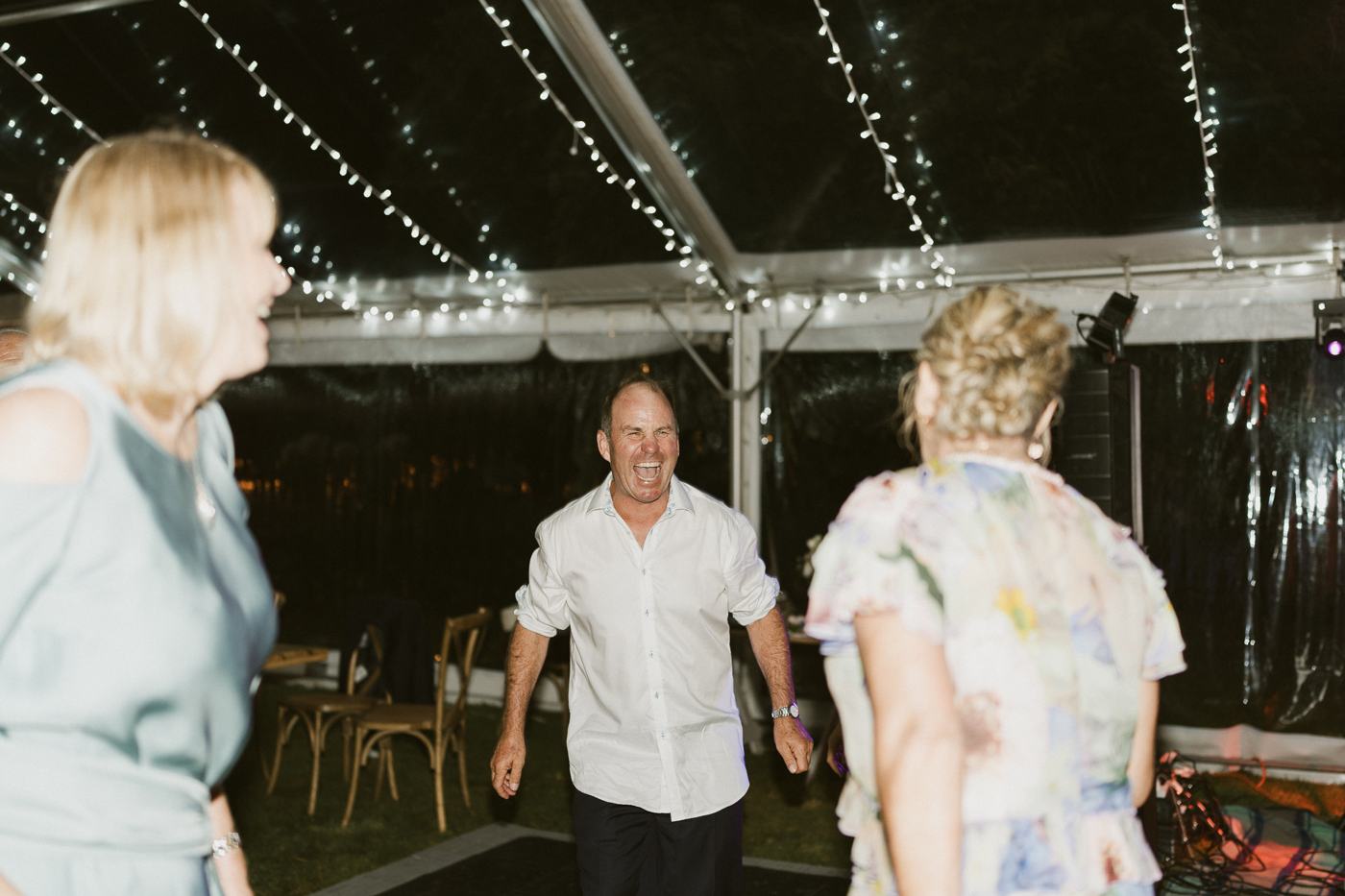
So look at your own day. If the ceremony is outdoors at 3pm and the reception is in a dim hall, ask to see work from both situations. Ask how the photographer handles a room with mixed light and how they would manage the first dance in low light. You want a calm, specific answer that shows they have met this problem before.
A vetting routine you can do in one evening
This routine turns a fog of impressions into a short, comparable set of answers.
- Pick two or three photographers whose work you like. More than that and you will compare noise.
- For each, find the contract or terms. If they will not send them before you pay, treat that as the first flag.
- Send the same short list of questions to every studio: who will photograph our wedding, what happens if you cannot attend, what are the cancellation and rescheduling terms, what is the payment schedule, what is the delivery window and how many edited images, and can we see one whole wedding.
- Compare the replies side by side. You are looking for specific written answers. A short, warm email with real numbers beats a long, enthusiastic one with none.
- Check the answers against the High rows in the table above. Anything that fails there is settled before you consider taste.
- Only then ask which photographer you actually want in the room, because the risk checks are done and the decision can be about people.
Asking every studio the same thing, including ones you already like, also shows you whose answers change depending on who is asking. The questions to ask a wedding photographer article has a longer set if you want more.
One last point on honest pushback. A photographer who tells you that an idea will not work with your venue’s light or your timeline is doing their job. Disagreement of that kind is a good sign. Evasiveness and vagueness are the flags, and plain disagreement is something you can make use of.
What to do next
- Write down your own non-negotiables before you start comparing: the hours you need, your style, the payment schedule you can manage. It is easier to spot a gap when you know the shape of what you want.
- Ask every studio on your shortlist the same six questions from the routine above, in writing, and keep the replies in one place.
- Ask each of them for one whole wedding gallery, and read it the way the gallery article above describes.
- Read each contract slowly, mark anything you do not understand, and ask for the High-severity items in writing before you pay a deposit.
- See how TZ works on the investment page, and meet the photographer on the about page.
If you are comparing studios right now and want a straight answer on your date, check your date. You will hear whether it is free, and what the day could look like if it is.